


Simply put, a prime number is any positive integer greater than 1 that can only be divided by 1 and itself without a remainder (e.g., 2, 3, 5, 7, 11). There are 25 prime numbers between 1 and 100, and 168 prime numbers from 1 to 1,000.
Key Prime Number Rules at a Glance:
- 2 is unique: It is both the smallest prime number and the only even prime number.
- 1 is NOT prime: A prime number must have exactly two factors. 1 only has one factor.
- Formulas to test primes: Most primes can be expressed in the form of $6n \pm 1$.
In this guide, you’ll find:
- 📊 Complete Prime Tables: Searchable lists for 1–100, 1–500, and 1–1000.
- 👯 Twin Primes & Properties: Examples of prime pairs (like 11 and 13).
- 🔍 2-Step Verification Methods: How to instantly check if a large number is prime.
- 🛠️ Interactive Tool: Use our built-in Prime Checker below to test any number in seconds!

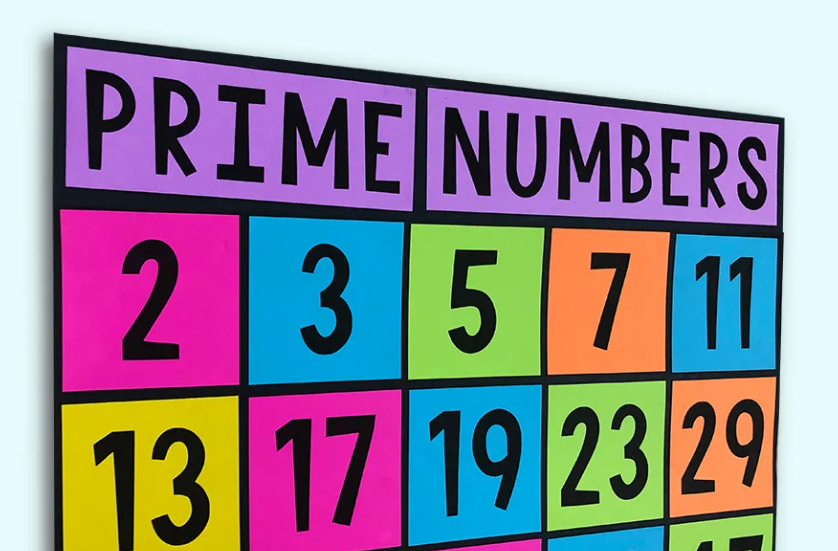
What are Prime Numbers?
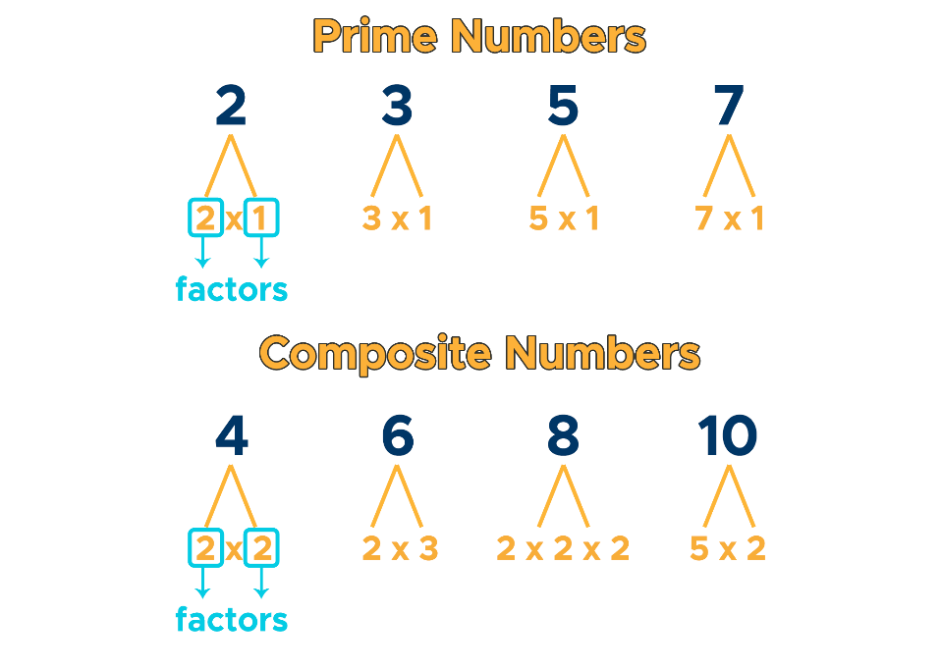
Prime numbers are numbers that have only two factors, that are, 1 and the number itself. For example, 3 is only divisible by 1 and 3. Therefore, 3 is a prime number! 7 is also a prime number because its only factors are 1 and 7.
Let’s look at the number 6. 6 is divisible by 1, 2, 3, and 6, so it has four factors, 1, 2, 3, and 6. It has more than two factors. Therefore, it is not prime, it is a composite number.
You can quickly find out the factors of a number by multiplying it.

Prime Numbers Definition
A prime number is any positive integer that is divisible only by itself and the number 1. This is the most basic definition of a prime number.

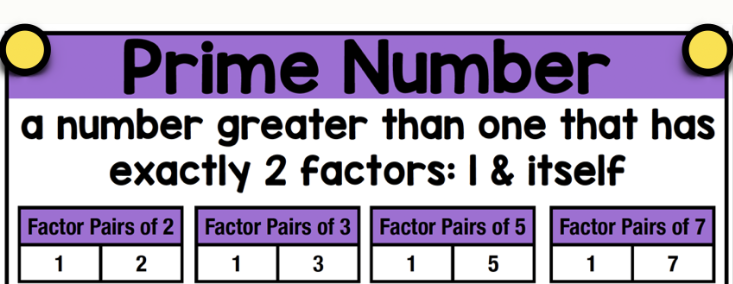
The first ten prime numbers: 2, 3, 5, 7, 11, 13, 17, 19, 23, 29.
Note: It is important to note that 1 is neither prime nor composite because it has only one factor, which is itself. It is a unique number.
Properties of Prime Numbers
If you are unsure whether a number is a prime number, you can determine this by following the properties of prime numbers listed below.
- Prime numbers are natural numbers greater than 1. Every number greater than 1 can be divided by at least one prime number.
- 2 is the smallest prime number.
- 2 is the only even prime number. All the prime numbers except 2 are odd numbers.
- Any two distinct prime numbers are always coprime to each other.
- Every even positive integer greater than 2 can be expressed as the sum of two primes.
- Every positive integer greater than 1 has at least one prime factor.
- Each composite number can be factored into prime factors and individually all of these are unique.
Prime Numbers Online Tool
Prime Number Explorer: Click a number to find out!
Click any number from 1 to 100 to see if it is prime or composite. You can also type any number below.
Hint: A prime number has exactly two factors — 1 and itself. The number 1 is neither prime nor composite.
List of Prime Numbers
Now, let's look at the complete list of prime numbers from 1 to 1000. We should remember that 1 is not a prime number because it has only one factor. Therefore, the prime numbers start at 2.
List of Prime Numbers 1 to 100
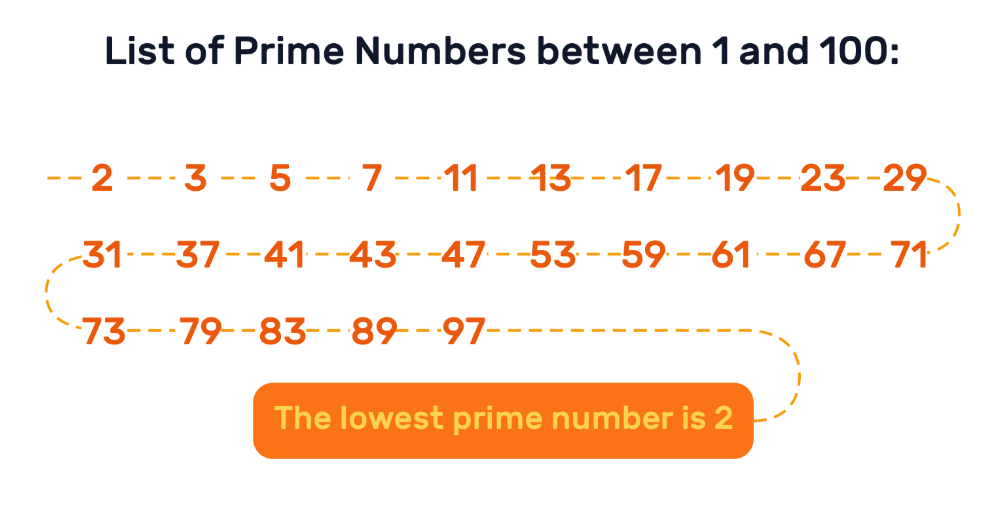
Here is a list of prime numbers from 1 to 100:
| List of Numbers | Prime Numbers List |
|---|---|
| 1-10 | 2, 3, 5, 7 |
| 11-20 | 11, 13, 17, 19 |
| 21-30 | 23, 29 |
| 31-40 | 31, 37 |
| 41-50 | 41, 43, 47 |
| 51-100 | 53, 59, 61, 67, 71, 73, 79, 83, 89, 97 |
There are 25 prime numbers from 1 to 100.

List of Prime Numbers 1 to 1000
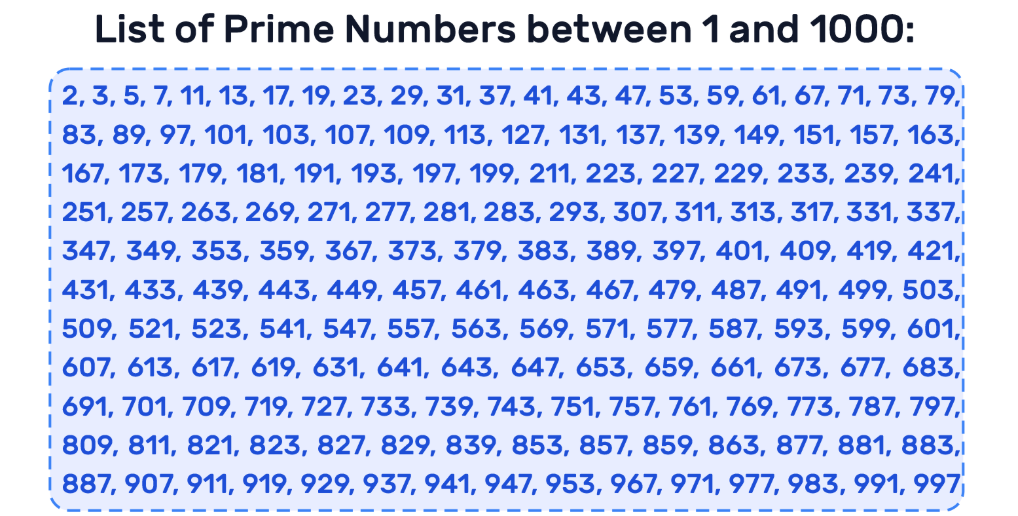
Here is the complete table of prime numbers from 1 to 1000:
| List of Numbers | Prime Numbers List |
|---|---|
| 1 to 100 | 2, 3, 5, 7, 11, 13, 17, 19, 23, 29, 31, 37, 41, 43, 47, 53, 59, 61, 67, 71, 73, 79, 83, 89, 97 |
| 101-200 | 101, 103, 107, 109, 113, 127, 131, 137, 139, 149, 151, 157, 163, 167, 173, 179, 181, 191, 193, 197, 199 |
| 201-300 | 211, 223, 227, 229, 233, 239, 241, 251, 257, 263, 269, 271, 277, 281, 283, 293 |
| 301-400 | 307, 311, 313, 317, 331, 337, 347, 349, 353, 359, 367, 373, 379, 383, 389, 397 |
| 401-500 | 401, 409, 419, 421, 431, 433, 439, 443, 449, 457, 461, 463, 467, 479, 487, 491, 499 |
| 501-600 | 503, 509, 521, 523, 541, 547, 557, 563, 569, 571, 577, 587, 593, 599 |
| 601-700 | 601, 607, 613, 617, 619, 631, 641, 643, 647, 653, 659, 661, 673, 677, 683, 691 |
| 701-800 | 701, 709, 719, 727, 733, 739, 743, 751, 757, 761, 769, 773, 787, 797 |
| 801-900 | 809, 811, 821, 823, 827, 829, 839, 853, 857, 859, 863, 877, 881, 883, 887 |
| 901-1000 | 907, 911, 919, 929, 937, 941, 947, 953, 967, 971, 977, 983, 991, 997 |
From the complete list of primes above, we can see that the total number of primes from 1 to 1000 is 168, each with only two factors.

Odd Prime Numbers List
It is worth noting that all primes are odd except for the number 2, which is even. Interestingly, 2 is the only even prime number. This means that the list of odd primes can start at 3 and go on from there since the rest of the primes are odd.
For example, 3, 5, 7, 11, 13, 17, 19, 23, 29, 31, 37, 41, 43, 47, 53, 59, 61, 67, 71, 73, 79, 83, 89, and so on are all odd primes.
Twin Prime Number List
As a reference, in this section, we will give you some information about twin prime numbers.
Two prime numbers are called twin prime numbers if there is only one composite number between them. In other words, two prime numbers with a difference of 2 are called twin prime numbers.
- For example, (3,5) is a twin prime because the difference between the two numbers is 5 - 3 = 2.
The alternative names, given to twin primes are prime twin or prime pair.
Twin prime numbers list
The list of twin prime numbers from 1 to 1000 are given here.
- Twin prime numbers from 1 to 50
{3, 5}, {5, 7}, {11, 13}, {17, 19}, {29, 31}, {41, 43}
- Twin prime numbers from 51 to 100
{59, 61}, {71, 73}
- Twin prime numbers from 101 to 200
{101, 103}, {107, 109}, {137, 139}, {149, 151}, {179, 181}, {191, 193}, {197, 199}
- Twin prime numbers from 201 to 300
{227, 229}, {239, 241}, {269, 271}, {281, 283}
- Twin prime numbers from 301 to 400
{311, 313}, {347, 349}
- Twin prime numbers from 401 to 500
{419, 421}, {431, 433}, {461, 463}
- Twin prime numbers from 501 to 1000
{521, 523}, {569, 571}, {599, 601}, {617, 619}, {641, 643}, {659, 661}, {809, 811}, {821, 823}, {827, 829}, {857, 859}, {881, 883}
Prime And Composite Numbers
- A prime number is a number greater than 1 that has exactly two factors, whereas a composite number has more than two factors. For example, 5 has only one factor, 1 × 5 (or) 5 × 1. Therefore, 5 is a prime number.
- A composite number is a number greater than 1 that has more than two factors. For example, 4 has more than one factor and the factors of 4 are 1, 2, and 4. It has more than two factors and hence, 4 is a composite number.

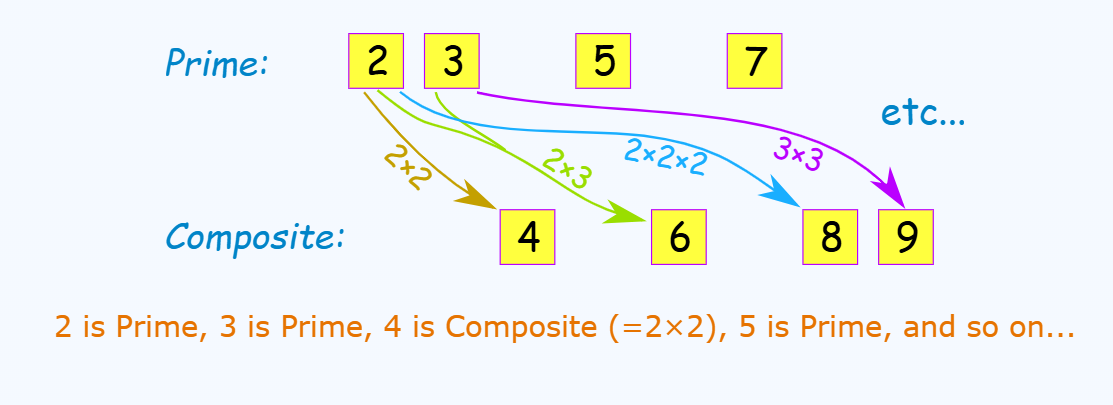
Let us understand the difference between prime numbers and composite numbers with the help of the table below:
| Prime Numbers | Composite Numbers |
|---|---|
| Numbers, greater than 1, having only two factors, 1 and the number itself | Numbers greater than 1 having at least three factors |
| 2 is the smallest and the only even prime number | 4 is the smallest composite number |
| Examples of prime numbers are 2, 3, 5, 7, 11, 13, and so on. | Examples of composite numbers are 4, 6, 8, 9, 10, and so on. |
How to Find Prime Numbers?
Above we covered the basic information about prime numbers, so how can you tell if a number is prime or not? How do you find out the prime numbers? The following two methods will help you to find whether the given number is a prime or not.
Method 1
We know that 2 is the only even prime number. And only two consecutive natural numbers, 2 and 3, are prime. Apart from those, every prime number can be written as 6n + 1 or 6n - 1 (except for multiples of primes, i.e., 2, 3, 5, 7, 11), where n is a natural number.
For example:
6(1) – 1 = 5
6(1) + 1 = 7
6(2) – 1 = 11
6(2) + 1 = 13
6(3) – 1 = 17
6(3) + 1 = 19
6(4) – 1 = 23
6(4) + 1 = 25 (multiple of 5)
Method 2
To find out the number of primes greater than 40, you can use the following formula.
n² + n + 41, where n = 0, 1, 2, ….., 39
For example:
(0)² + 0 + 41 = 41
(1)² + 1 + 41 = 43
(2)² + 2 + 41 = 47
Prime Number Examples
Now that you know the rules and formulas, it’s time to put your skills to the test! Before we look at the answers below, why not try our Interactive Magic Checker?
You can type any number from 1 to 1000 to see if it’s a "Prime Hero" or a "Composite Monster" instantly!
🪄 Prime Number Magic Checker
Type any number between 1 and 1000 to see if it's a Prime Hero or a Composite Monster!
Let's look at some classic examples to see how it works in detail:
Example 1. From the list of prime numbers 1 to 1000 given above, find if 825 is a prime number or not.
Answer: The list of prime numbers from 1 to 1000 does not include 825 as a prime number.
- It is a composite number since it has more than two factors. We can confirm this by prime factorization of 825 also.
- Prime Factorization of 825 = 3¹ x 5² x 11¹
- Hence, 825 includes more than two factors.
Example 2. Is 10 a Prime Number?
Answer: No, because it can be divided evenly by 2 or 5, 2×5=10, as well as by 1 and 10.
- Alternatively, using method 1, let us write in the form of 6n ± 1.
- 10 = 6(1) + 4 = 6(2) – 2
- This is not of the form 6n + 1 or 6n – 1.
- Hence, 10 is not a prime number.
Example 3. What is the greatest prime number between 80 and 90?
Answer: The prime numbers between 80 and 90 are 83 and 89.
So, 89 is the greatest prime number between 80 and 90.
Example 4. What are prime numbers between 1 and 50?
The list of prime numbers between 1 and 50 are:
2, 3, 5, 7, 11, 13, 17, 19, 23, 29, 31, 37, 41, 43, 47.
FAQs on Prime Numbers List
A prime number is a number that has only two factors, that is, 1 and the number itself. For example, 2, 3, 5, and 7 are prime numbers.
Co-prime numbers are the set of numbers whose Highest Common Factor (HCF) is 1. For example, 2 and 3 are co-prime numbers.
The prime numbers should be only whole numbers, and all the whole numbers are greater than 1. Therefore, a prime number cannot be negative.
There is only one even prime number between 1 to 500. This is because 2 has only 1 and itself as its factors. 2 is the only even prime number.
Discovering the maths whiz in every child,
that's what we do.
Suitable for students worldwide, from grades K-12.
Get started free!

Nathan, a graduate of the University of New South Wales, brings over 9 years of expertise in teaching Mathematics and Science across primary and secondary levels. Known for his rigorous yet steady instructional style, Nathan has earned high acclaim from students in grades 1-12. He is widely recognized for his unique ability to blend academic rigor with engaging, interactive lessons, making complex concepts accessible and fun for every student. Nathan also has extensive experience helping students prepare for the AMC 8 and Math Kangaroo competitions, guiding them to achieve outstanding results in international math contests.