


In Chinese culture, the snake (蛇, shé) symbolizes wisdom, transformation, and spiritual power.
As the sixth animal in the 12-year Chinese zodiac cycle, the Snake represents intuition, resourcefulness, and deep thinking. In mythology, snakes embody rebirth through skin-shedding and appear as divine beings in creation stories—notably Nüwa and Fuxi, the progenitor deities depicted with human heads and serpent bodies.


How to Say “Snake” in Mandarin Chinese
The Mandarin word for snake is 蛇 (shé), pronounced with a rising second tone. The character combines two radicals:
Learn authentic Chinese from those who live and breathe the culture.
Specially tailored for kids aged 3-18 around the world!
Get started free!| Component | Meaning | Function |
|---|---|---|
| 虫 (chóng) | Insect/creature radical | Indicates the character belongs to the animal/reptile category |
| 它 (tā) | It (pronoun) | Provides phonetic hint (tā → shé in historical sound change) |


Pronunciation note: The “sh” in shé is a retroflex consonant—curl the tongue back toward the hard palate. The “é” is a mid-front vowel similar to the “e” in “bed” but held longer.
Common phrases with 蛇 (shé):
画蛇添足 (huà shé tiān zú) — “Draw a snake and add feet” (idiom meaning to ruin the effect by adding something superfluous)
蛇年 (shé nián) — Year of the Snake
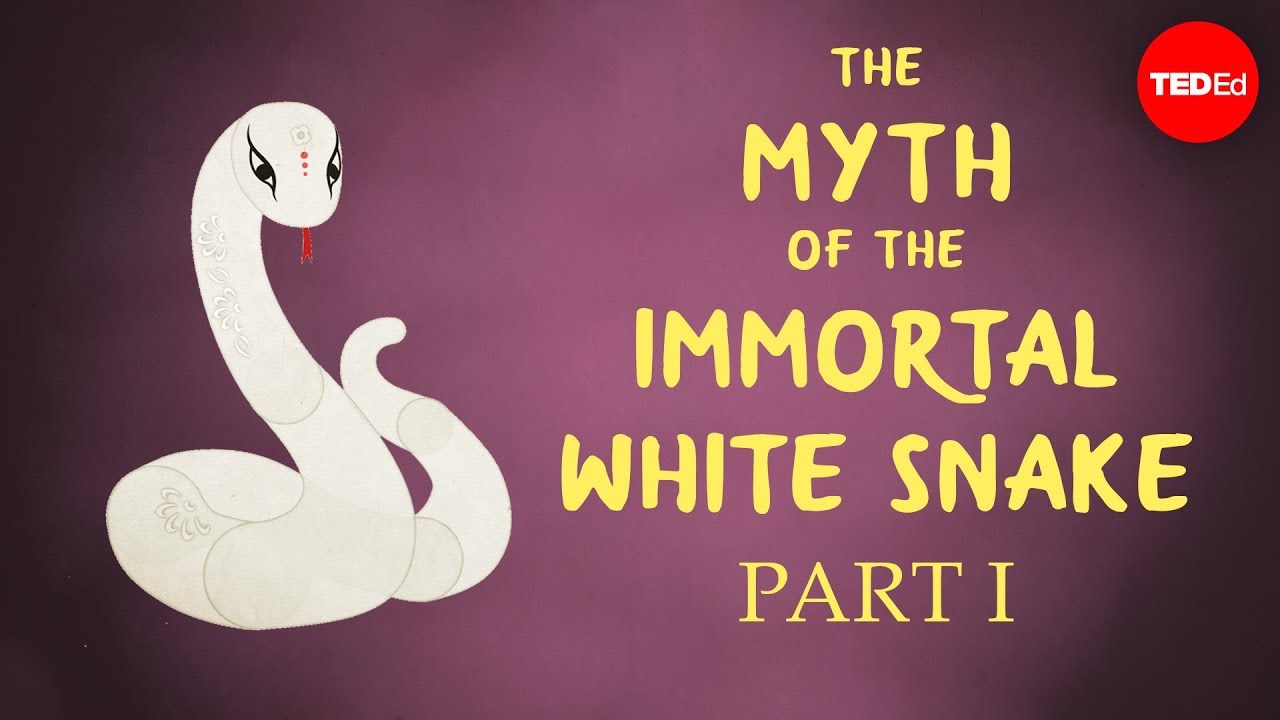
白蛇 (bái shé) — White Snake (referencing the Legend of the White Snake)


The Snake in the Chinese Zodiac: Position, Legend, and Traits
Where Does the Snake Rank in the Zodiac?
The Snake is the sixth animal in the 12-year Chinese zodiac cycle, following the Dragon and preceding the Horse. The complete cycle order is:
| Position | Animal | Earthly Branch | Recent Years |
|---|---|---|---|
| 1 | Rat (鼠) | Zi | 2020, 2032 |
| 2 | Ox (牛) | Chou | 2021, 2033 |
| 3 | Tiger (虎) | Yin | 2022, 2034 |
| 4 | Rabbit (兔) | Mao | 2023, 2035 |
| 5 | Dragon (龙) | Chen | 2024, 2036 |
| 6 | Snake (蛇) | Si | 2025, 2037 |
| 7 | Horse (马) | Wu | 2026, 2038 |
| 8 | Goat (羊) | Wei | 2027, 2039 |
| 9 | Monkey (猴) | Shen | 2028, 2040 |
| 10 | Rooster (鸡) | You | 2029, 2041 |
| 11 | Dog (狗) | Xu | 2030, 2042 |
| 12 | Pig (猪) | Hai | 2031, 2043 |


The Zodiac Race Legend: How the Snake Earned Sixth Place
The zodiac order derives from the Great Race (生肖赛跑) called by the Jade Emperor. In this myth:
- The Rat rode the Ox across the river and jumped off at the finish line to secure first place
- The Ox came second
- The Tiger, Rabbit, and Dragon followed
- The Snake, using its cunning, wrapped itself around the Horse’s leg and sprang forward at the last moment to claim sixth place—just ahead of the Horse
This legend reinforces the Snake’s cultural association with strategic thinking and calculated action rather than brute force.


The Five Elements of the Snake: Wood, Fire, Earth, Metal, Water
In Chinese astrology, each zodiac animal combines with one of the Five Elements (五行, wǔ xíng)—Wood, Fire, Earth, Metal, Water—creating a 60-year cycle. The element modifies the Snake’s core traits:
| Element | Birth Years | Personality Profile | Strengths | Weaknesses |
|---|---|---|---|---|
| Wood Snake (木蛇) | 1965, 2025 | Creative, sociable, team-oriented | Innovation, collaboration | Indecisive, overly accommodating |
| Fire Snake (火蛇) | 1977, 2037 | Passionate, charismatic, dominant | Leadership, persuasion | Impulsive, temperamental |
| Earth Snake (土蛇) | 1989, 2049 | Practical, reliable, cautious | Stability, long-term planning | Overly conservative, risk-averse |
| Metal Snake (金蛇) | 1941, 2001 | Ambitious, disciplined, determined | Goal achievement, resilience | Stubborn, uncompromising |
| Water Snake (水蛇) | 1953, 2013 | Intelligent, adaptable, communicative | Diplomacy, intuition | Manipulative, emotionally detached |

The Snake in Chinese Mythology: Divine Beings and Transformation
Nüwa (女娲) and Fuxi (伏羲): The Serpent Progenitors
The most significant snake figures in Chinese mythology are Nüwa and Fuxi, sibling-spouse deities credited with creating human civilization:
| Deity | Role | Snake Association |
|---|---|---|
| Nüwa | Creator goddess; mender of the broken sky | Depicted with human head and serpent body; created humanity from yellow clay |
| Fuxi | Cultural hero; inventor of the Eight Trigrams (八卦) | Also depicted with human head and serpent body; taught fishing, hunting, and writing |
Archaeological evidence from Neolithic Yangshao culture (5000–3000 BCE) shows Nüwa-Fuxi iconography on painted pottery, confirming the serpent-deity concept predates written records. The intertwined snake bodies of Nüwa and Fuxi symbolize yin-yang unity and the cosmic duality of creation.
The Legend of the White Snake (白蛇传, Bái Shé Zhuàn)
The Legend of the White Snake is one of China’s Four Great Folktales (四大民间传说), alongside the Butterfly Lovers, Lady Meng Jiang, and the Cowherd and Weaver Girl.
Plot summary: Bai Suzhen (白素贞), a white snake spirit who has cultivated immortality for 1,000 years, transforms into a beautiful woman and falls in love with Xu Xian (许仙), a human herbalist. Their love is tested by Fa Hai (法海), a Buddhist monk who views the union as unnatural. The story explores themes of transformation, forbidden love, sacrifice, and the tension between human and divine realms.
Cultural significance: The tale has been adapted into Peking opera, Kunqu opera, films, TV series, and animation over centuries. The 1992 TV series New Legend of Madame White Snake starring Angie Chiu remains the definitive version for many Chinese viewers.
The Symbolism of Skin-Shedding: Rebirth and Renewal
The snake’s biological ability to shed its skin (ecdysis) carries profound symbolic weight in Chinese philosophy:
- Personal transformation: Casting off old habits, beliefs, or identities to embrace growth
- Cyclical renewal: Alignment with the Daoist concept of constant change (变, biàn)
- Immortality symbolism: The snake “renews” itself periodically, unlike creatures that age linearly
- Healing associations: In traditional Chinese medicine, snake venom and skin are used in remedies for rheumatism and skin conditions
The Snake in Chinese Astrology: Yin-Yang and Element Theory
In the yin-yang (阴阳) framework, the Snake is classified as yin (阴)—receptive, introspective, and internal—despite its active, strategic nature. This paradox reflects the Chinese philosophical understanding that apparent passivity can mask deep activity.
The Snake’s association with the Fire element in the zodiac cycle (not to be confused with the Five Elements above) further complicates its profile: a yin animal with yang/fire energy creates a balanced but complex archetype—internally driven but capable of external charisma when necessary.
How Is the Snake Viewed in Modern Chinese Society?
Contemporary Chinese attitudes toward snakes reflect a tension between traditional reverence and modern pragmatism:
| Context | Traditional View | Modern View |
|---|---|---|
| Zodiac identity | Source of pride; Snake-born wear the sign as a marker of wisdom | Still culturally significant, especially during Lunar New Year |
| As pets | Historically rare; snakes associated with wild nature | Growing popularity among urban youth as exotic pets |
| In medicine | Snake venom and gallbladder valued in TCM | Regulated trade; conservation concerns limit traditional use |
| In language | Positive: “灵蛇” (líng shé, divine snake); Negative: “蛇蝎心肠” (shé xiē xīn cháng, heart of snake and scorpion—cruel) | Idioms remain in active use; “画蛇添足” taught in elementary schools |
Learn authentic Chinese from those who live and breathe the culture.
Specially tailored for kids aged 3-18 around the world!
Get started free!

Master’s degree in International Chinese Education from Peking University. Dedicated to the field of Chinese language education, with 7 years of experience as an international Chinese language teacher.