

A 30-60-90 triangle is a special right triangle with angles of 30°, 60°, and 90°. Its sides follow a fixed ratio of 1 : √3 : 2. The shortest leg (opposite the 30° angle) equals x, the longer leg (opposite the 60° angle) equals x√3, and the hypotenuse (opposite the 90° angle) equals 2x. You can solve for any missing side if you know just one side length. This triangle appears frequently in geometry, trigonometry, and standardized tests like the SAT and ACT.


What Is a 30-60-90 Triangle?
A 30-60-90 triangle is a right triangle with three specific angles: 30 degrees, 60 degrees, and 90 degrees. It belongs to the family of special right triangles because its side lengths follow a consistent, predictable pattern. You do not need the Pythagorean theorem every time — you can use the ratio instead.


The 30° angle sits opposite the shortest side. The 60° angle sits opposite the medium-length side. The 90° angle sits opposite the longest side, called the hypotenuse. This angle-to-side relationship never changes, which makes the triangle easy to work with.
Discovering the maths whiz in every child,
that’s what we do.
Suitable for students worldwide, from grades K-12.
Get started free!You can think of a 30-60-90 triangle as half of an equilateral triangle cut along its altitude. When you split an equilateral triangle (all sides equal, all angles 60°) down the middle, you get two congruent 30-60-90 triangles. This geometric relationship explains why the side ratio works the way it does.
⚡ Quick Reference: 30-60-90 Triangle at a Glance
| Property | Value |
| Angles | 30° / 60° / 90° |
| Side Ratio | 1 : √3 : 2 |
| Short Leg (x) | Opposite 30° |
| Long Leg (x√3) | Opposite 60° |
| Hypotenuse (2x) | Opposite 90° |
Memory trick: “Short = x, Long = x√3, Hyp = 2x.”

🧮 Interactive Side Calculator
This article provides an interactive tool that instantly calculates the missing sides of a 30-60-90 triangle. You can enter any one side length – short leg, long leg, or hypotenuse – and the tool will output the other two sides using the 1:√3:2 ratio. It also computes area and perimeter automatically. This saves time on homework and reduces arithmetic errors with radicals.
30-60-90 Triangle Calculator
Enter the length of one side:
Results:
30-60-90 Triangle Side Rules
Rule 1: The Short Leg Determines Everything
The short leg sits opposite the 30° angle and acts as the base value x. Every other side length derives from this single value. If you know the short leg, multiply by √3 to get the long leg and multiply by 2 to get the hypotenuse.
Rule 2: The Long Leg Equals Short Leg Times Root 3
The long leg sits opposite the 60° angle. Its length always equals the short leg multiplied by √3 (approximately 1.732). This relationship stays constant no matter how large or small the triangle grows.
Rule 3: The Hypotenuse Equals Twice the Short Leg
The hypotenuse sits opposite the 90° angle. Its length always equals twice the short leg (2x). This is the longest side of the triangle, and it connects the two acute angles.
Rule 4: Angles Relate Directly to Side Lengths
The smallest angle (30°) pairs with the shortest side. The medium angle (60°) pairs with the medium side. The largest angle (90°) pairs with the longest side. Larger angles always open to longer sides in any triangle.
Rule 5: The Triangle Is Half an Equilateral Triangle
A 30-60-90 triangle forms when you cut an equilateral triangle along its height. The base of the original equilateral triangle becomes the hypotenuse of the right triangle. The altitude of the equilateral triangle becomes the long leg of the right triangle.
30-60-90 Triangle Formulas
Side Length Formulas
| If You Know… | Short Leg (x) | Long Leg (x√3) | Hypotenuse (2x) |
| Short leg (x) | — | x × √3 | x × 2 |
| Long leg (x√3) | long leg ÷ √3 | — | (long leg ÷ √3) × 2 |
| Hypotenuse (2x) | hypotenuse ÷ 2 | (hypotenuse ÷ 2) × √3 | — |
Area Formula
Area = (x × x√3) / 2 = (x²√3) / 2
Perimeter Formula
Perimeter = x + x√3 + 2x = x(3 + √3)
The 1:√3:2 Ratio Explained
The 1 : √3 : 2 ratio describes the proportional relationship between all three sides of a 30-60-90 triangle. The number 1 corresponds to the short leg, √3 corresponds to the long leg, and 2 corresponds to the hypotenuse. This ratio holds true for every 30-60-90 triangle, regardless of size.
How to Derive the Ratio
Start with an equilateral triangle where every side measures 2 units. Draw a vertical line from the top vertex down to the midpoint of the base. This line splits the base into two segments of 1 unit each and creates two identical right triangles.
Each new right triangle has a base of 1 unit and a hypotenuse of 2 units. Use the Pythagorean theorem to find the height: a² + b² = c² becomes 1² + h² = 2², so 1 + h² = 4, and h² = 3. The height equals √3.
You now have a triangle with sides 1, √3, and 2. The angles measure 30° (opposite the side of 1), 60° (opposite the side of √3), and 90° (opposite the side of 2). This derivation proves the ratio works for all 30-60-90 triangles.
How to Apply the Ratio
Identify which side you already know. Match that side to its position in the ratio (1 for short leg, √3 for long leg, 2 for hypotenuse). Find the scaling factor x, then multiply by the other ratio values to find the missing sides.
For example, if the hypotenuse measures 10, divide by 2 to find x = 5. The short leg equals 5, and the long leg equals 5√3 (approximately 8.66).
Solved Examples and Practice Problems (With Worksheet)
Solved Examples
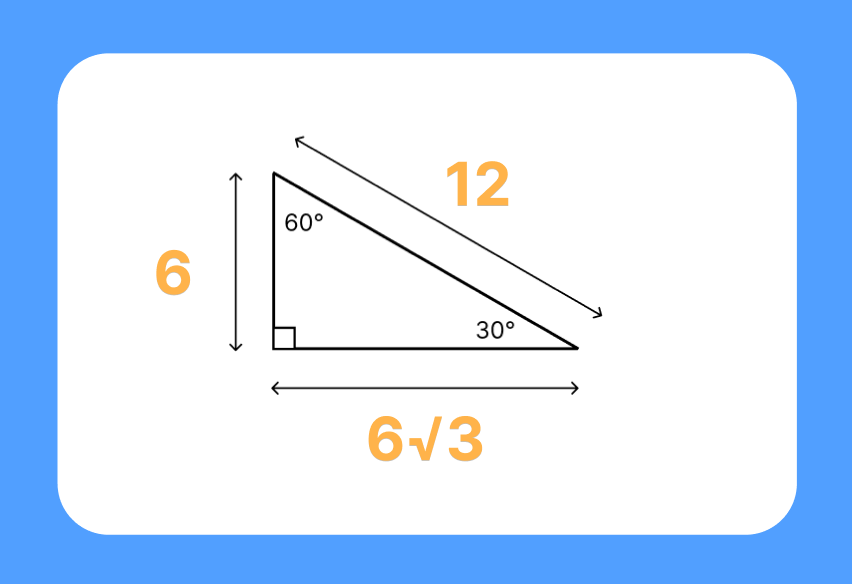
Question 1. Find the missing side lengths of a 30 60 90 triangle if the shortest side is 6 units.
- Given: Shortest side (a) = 6 units
- Using the 30 60 90 triangle formulas:
- Medium side (b) = a√3 = 6√3 ≈ 10.39 units
- Longest side (c) = 2a = 2 × 6 = 12 units

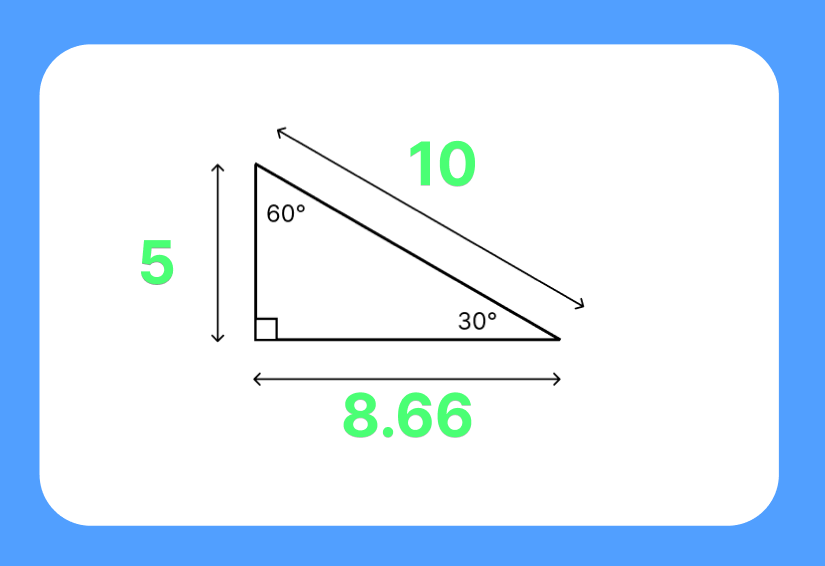
Question 2. In a 30 60 90 triangle, the hypotenuse is 10 units. Find the lengths of the other two sides.
- Given: Hypotenuse (c) = 10 units
- Using the 30 60 90 triangle formulas:
- Shortest side (a) = c/2 = 10/2 = 5 units
- Medium side (b) = a√3 = 5√3 ≈ 8.66 units

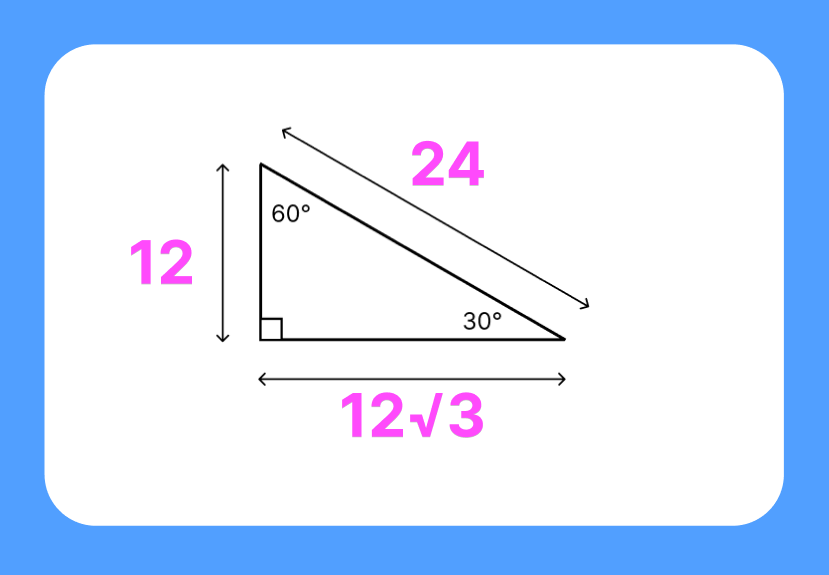
Question 3. The medium side of a 30 60 90 triangle is 12 units. Find the lengths of the other two sides.
- Given: Medium side (b) = 12 units
- Using the 30 60 90 triangle formulas:
- Shortest side (a) = b/√3 = 12/√3 ≈ 6.93 units
- Longest side (c) = 2b = 2 × 12 = 24 units

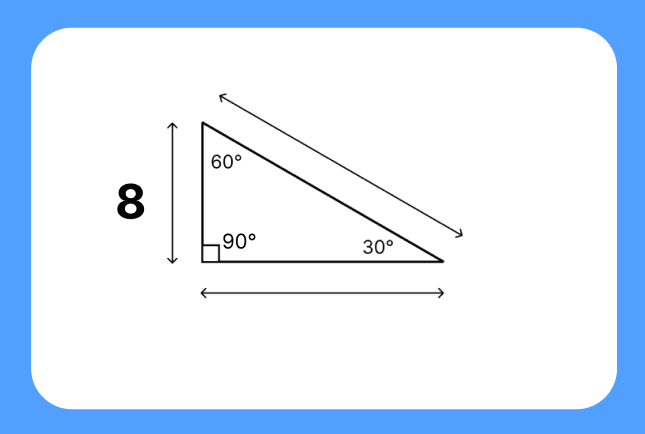
Question 4. The shortest side of a 30 60 90 triangle is 8 units. Find the angle measures.
- Given: Shortest side (a) = 8 units
- Using the 30 60 90 triangle rules:
- Angle 1 = 30 degrees
- Angle 2 = 60 degrees
- Angle 3 = 90 degrees

Question 5. The longest side of a 30 60 90 triangle is 18 units. Find the lengths of the other two sides.
- Given: Longest side (c) = 18 units
- Using the 30 60 90 triangle formulas:
- Shortest side (a) = c/2 = 18/2 = 9 units
- Medium side (b) = a√3 = 9√3 ≈ 15.59 units

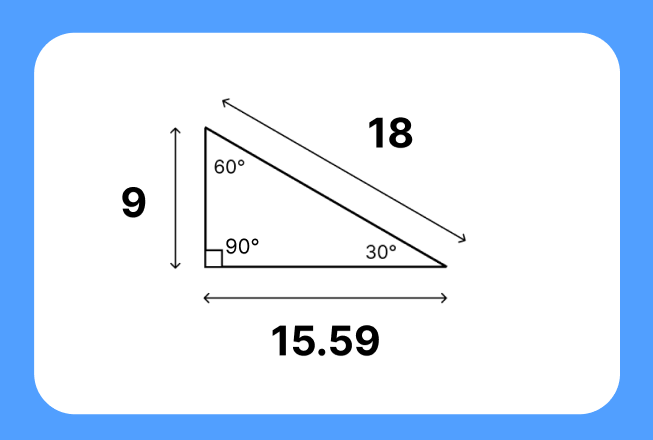
30 60 90 Triangle Worksheet – Download for free
To further practice working with 30 60 90 triangles, you can download a free worksheet here: [link to worksheet].
Practice Problems
- Short leg = 5 → Find long leg and hypotenuse.
- Hypotenuse = 30 → Find both legs.
- Long leg = 9√3 → Find short leg and hypotenuse.
- Short leg = 12 → Find area and perimeter.
Answers:
- Long = 5√3, Hypotenuse = 10
- Short = 15, Long = 15√3
- Short = 9, Hypotenuse = 18
- Area = 72√3, Perimeter = 36 + 12√3
Common Mistakes to Avoid
Even with the simple 1:√3:2 ratio, students often make a few predictable errors. Here are the most common mistakes to watch for:
Mistake 1: Confusing the Long Leg with the Hypotenuse
The long leg (x√3) and the hypotenuse (2x) are easy to mix up because both are “long.” Remember: the hypotenuse is always opposite the 90° angle and is always the longest side. The long leg is opposite the 60° angle and is shorter than the hypotenuse. When a problem gives you a side, double-check which angle it sits across from before you plug it into a formula.
Mistake 2: Dividing by 2 When You Should Divide by √3
This is the #1 trap. If the problem gives you the long leg, do not divide by 2. Dividing by 2 only works when you have the hypotenuse. For the long leg, divide by √3 (or multiply by √3/3) to find the short leg.
Mistake 3: Forgetting to Rationalize the Denominator
When you divide by √3, your answer has a radical in the denominator (e.g., 6/√3). Always rationalize it: multiply the numerator and denominator by √3 to get 6√3/3 = 2√3. This is the standard form expected in most math classes and on standardized tests.
Mistake 4: Mixing Up 30-60-90 with 45-45-90
These are the two special right triangles, and they have different ratios. A 45-45-90 triangle has a ratio of 1 : 1 : √2. A 30-60-90 triangle has a ratio of 1 : √3 : 2. If you use the wrong ratio, every answer will be wrong.
SAT/ACT Quick Solutions for 30-60-90 Triangles
The 30-Second Scratch-Paper Method
When you see a 30-60-90 triangle on test day, write “x — x√3 — 2x” immediately on your scratch paper. Label which side matches which value. Then plug in the given number and solve for x. This habit prevents confusion and saves precious seconds.
Three Common SAT Question Types
1. Given the hypotenuse, find the area. Test makers love this one. Divide the hypotenuse by 2 to get x. Then use Area = (x²√3) / 2. Watch for answer choices that use the wrong leg as the base.
2. Triangle in a coordinate plane. The problem places vertices on a grid and asks for a missing coordinate or side length. Identify the right angle first, then match the sides to the 30-60-90 ratio. Pay attention to whether the short or long leg runs horizontally.
3. Combined with a circle. A 30-60-90 triangle sits inside or outside a circle, and the radius connects to one of the sides. The hypotenuse often equals the diameter, or a leg equals the radius. Always draw the radius and label what you know.
Trap Warning: The #1 Mistake
The most common error happens when students see the long leg and divide by 2 instead of √3. They confuse the long leg with the hypotenuse. Remember: only the hypotenuse gives you the short leg when you divide by 2. If you start with the long leg, you must divide by √3 to find x. Double-check which side the problem gives you before you calculate.
Build Your SAT Math Skills with WuKong
Mastering 30-60-90 triangles is just one piece of the SAT math puzzle. If you want to build confidence across every topic — from Algebra to Data Analysis — with guided practice and real test questions, WuKong’s 2026 SAT course offers structured support with 12 system lessons, 3 full mock exams, and a final review session. Available in small classes (4–12 students) or 1-on-1 coaching, it aligns with the 2026 test dates in March, May, and June.
FAQ
Q1: How do I identify a 30-60-90 triangle?
Check the angle measures first. If the triangle has angles of 30°, 60°, and 90°, it is a 30-60-90 triangle. You can also identify it from the side lengths. If the sides follow the ratio 1 : √3 : 2 (or any multiple of that ratio), you have a 30-60-90 triangle. The shortest side always pairs with the smallest angle.
Q2: What if I only know the long leg length?
Divide the long leg by √3 to find the short leg (x). Then multiply x by 2 to find the hypotenuse. For example, if the long leg measures 6√3, divide by √3 to get x = 6. The short leg equals 6 and the hypotenuse equals 12. Always rationalize the denominator if your answer contains a radical on the bottom.
Q3. What are some practical applications of 30-60-90 triangles?
- Roof construction (the 30-60-90 triangle is often used in the design of roofs)
- Electrical engineering (the 30-60-90 triangle is used in the analysis of three-phase electrical systems)
- Navigation (the 30-60-90 triangle is used in determining direction and distance)
Q4. How can I use the properties of 30-60-90 triangles to solve problems?
- Identify if a triangle is a 30-60-90 triangle.
- Use the side length relationships to find unknown side lengths.
- Apply the trigonometric ratios to solve for angles or other values.
- Utilize the properties in real-world applications, such as in construction or engineering.
Conclusion
The 30-60-90 triangle is one of the most useful special right triangles in geometry. Its fixed side ratio of 1 : √3 : 2 lets you solve for any missing side without the Pythagorean theorem. Remember that the short leg (opposite 30°) equals x, the long leg (opposite 60°) equals x√3, and the hypotenuse (opposite 90°) equals 2x. Master this ratio, and you will speed through homework, quizzes, and standardized test questions with confidence.


Ready to take your math skills to the next level? Explore WuKong Math for live online classes, expert teachers, and a curriculum designed to help students in grades 1–12 build a strong foundation and achieve math success.
Discovering the maths whiz in every child,
that’s what we do.
Suitable for students worldwide, from grades K-12.
Get started free!

Delvair, a graduate of the Federal University of Maranhão in Brazil, is a dedicated educator with over six years of experience in school-based mathematics instruction. She specializes in advanced math pedagogy, with a particular expertise in Math Kangaroo competition coaching. Driven by the belief that education is the bedrock of a thriving society, Delvair is committed to creating an empowering environment where every child can excel. She holds the firm conviction that with the right guidance, every student possesses the potential to master complex mathematical concepts.