


How many inches are in 5 feet?
A quick conversion: 5 feet × 12 = 60 inches. Simply remember that “1 foot = 12 inches,” and you can instantly arrive at the result by multiplying directly by 12.
Mastering conversions between U.S. customary length units (inches, feet, yards, and miles) is a key skill in the U.S. Common Core State Standards for Mathematics, covered in 4th grade under the Measurement and Data domain (standard 4.MD.A.1), and extends to Standard 5.MD.A.1, which involves solving real-world problems that span both metric and U.S. customary units. It helps students know relative sizes of units within one system, record measurement equivalents, and solve real-world problems involving length.
This article includes an online feet-to-inches converter, step-by-step conversion guide, common conversion table and real-world practice problems. Perfect for 4th and 5th grades.
Discovering the maths whiz in every child,
that’s what we do.
Suitable for students worldwide, from grades K-12.
Get started free!An Online Inches to Feet Converter
📏 Height & Length Converter / 长度换算器
Convert between Metric and Imperial units / 公制与英制单位转换
170 Centimeters (厘米) = 5.5774 Feet (英尺)
What Are Feet and Inches?
Feet (ft) and inches (in) are the most common length units in the U.S. customary measurement system, used daily to measure height, furniture, room size and more.
- Foot (ft): A medium-length unit, 1 foot = 12 inches. A standard dining table is about 2.5 feet tall.
- Inch (in): A smaller unit for precise measurements. The width of your thumb is roughly 1 inch.


Key Conversion Basics
The relationship “1 foot = 12 inches” is the core of all conversions between these units, and is explicitly required by CCSS.MATH.CONTENT.4.MD.A.1 for 4th grade students to memorize and apply.
How to Convert Feet to Inches [Step-by-Step Guide]
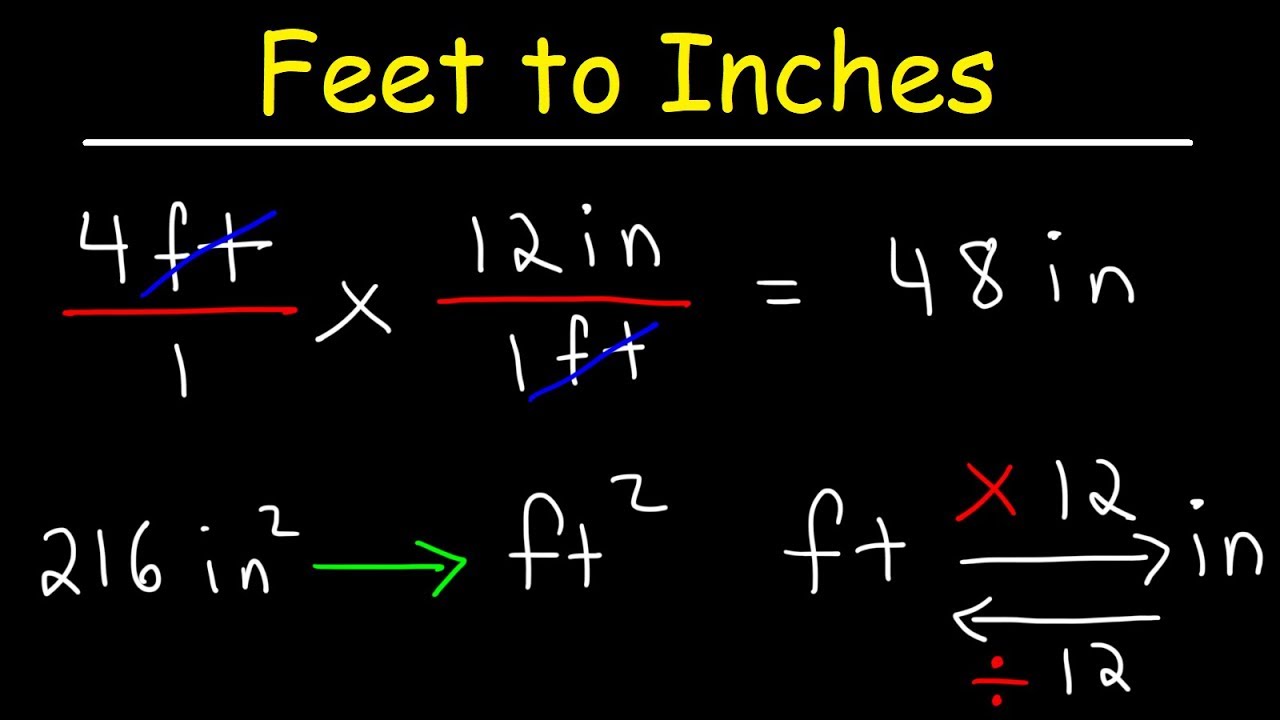
Converting between feet and inches is simple once you remember the 12:1 ratio.


Method 1: Convert Feet to Inches
Formula: Inches = Feet × 12
This multiplication conversion is the primary skill taught in 4th grade, where students learn to express larger units in terms of smaller units within the same system.
Step-by-Step:
- Identify the number of feet you want to convert
- Multiply that number by 12
- Label your answer with “inches”
Example: Convert 5 feet to inches
5 feet × 12 inches/foot = 60 inches
Method 2: Convert Inches to Feet and Inches
Formula: Feet = Total Inches ÷ 12
This division conversion with remainder handling is an extension for 5th grade students under CCSS.MATH.CONTENT.5.MD.A.1, who solve multi-step real-world problems involving unit conversion.
Step-by-Step:
- Divide the total number of inches by 12
- The whole number part is the number of feet
- The remainder is the number of remaining inches
Example: Convert 66 inches to feet and inches
66 inches ÷ 12 = 5 with a remainder of 6
So 66 inches = 5 feet 6 inches
Height Measurements in Feet and Inches
Height is often measured in feet and inches, especially in countries that use the imperial system. For instance, a male may be 6 feet tall, which is equivalent to 72 inches, while a female may be 5 feet 5 inches tall, or 65 inches. This kind of measurement is commonly used in medical settings, sports, and fitness assessments to understand a person’s height in relation to their body.


Common Feet to Inches Conversion Table
Use this table for quick reference:
| Feet | Inches | Common Real-World Reference |
|---|---|---|
| 1 foot | 12 inches | Length of a standard ruler |
| 2 feet | 24 inches | Height of a small suitcase |
| 3 feet | 36 inches | Width of a typical door |
| 4 feet | 48 inches | Height of a kitchen counter |
| 5 feet | 60 inches | Average height of a 10-11 year old child |
| 5.5 feet | 66 inches | Average height of an adult woman |
| 6 feet | 72 inches | Average height of an adult man |
The Metric System vs. Imperial System
The metric system is another widely used system of measurement, defined in terms of meters and centimeters. The primary difference between the metric and imperial systems lies in the units used. While the imperial system uses feet, inches, centimeters (cm), and yards (yd), the metric system uses meters and centimeters.
This difference can sometimes create confusion, especially when working with measurements across different countries.

Here are some common conversions:
- 1 foot = 0.3048 meters
- 1 inch = 2.54 centimeters
- 1 yard = 0.9144 meters
Examples of Measurement
Measurement is an important mathematical concept that everyone, from adults to students, needs to understand in order to navigate daily life effectively. Sometimes you need to measure the table height in feet inches to ensure it fits well in the space. Measurement plays a vital role in various contexts, such as height of human body, weight, and fabric dimensions.

Practical Applications
Conversions play a significant role in many aspects of everyday life. For instance, when cooking, recipes often require precise measurements; knowing how to convert between cups, ounces, and tablespoons can be the difference between a delicious meal and a culinary disaster.
Additionally, athletes often need to convert between different units of measurement in their training routines, whether it’s calculating their speed in miles per hour or converting their weight from pounds to kilograms for fitness assessments.


For instance, a person’s height is often expressed in foot and inch, such as “6 feet, one inch,” which equals 73 inches. In different countries, weight may be measured in pounds or kilograms, highlighting the importance of understanding various units.
Similarly, in the textile industry, fabric is commonly measured in yards (international yard), with its width typically expressed in inches. For example, a fabric that is 54 inches wide can be referred to as having a width of 1.5 yards.
We’ve all had those situations where finding the right shoe size feels like a daunting task. Knowing your foot size in inches can make it much easier to find the perfect fit.
Similarly, when designing a room, understanding the dimensions in foot and inch is crucial for choosing the right furniture. Being equipped with these measurements ensures that everything fits comfortably and looks great!
By mastering these conversion techniques, you can confidently navigate situations that involve both inches and feet, whether you’re filling out forms, engaging in DIY projects, or simply discussing your height with friends.
FAQs
5 feet is exactly 60 inches. This is a standardized conversion in the U.S. customary system.
Multiply the feet by 12 then add the remaining inches: 5×12 + 6 = 66 inches. This is a common 4th grade math problem.
52 inches ÷ 12 = 4 feet with a remainder of 4 inches, so 4 feet 4 inches.
This is first taught in 4th grade (CCSS.MATH.CONTENT.4.MD.A.1) and reinforced in 5th grade with more complex multi-step problems.
More Length & Height Conversion
Mastering length conversions is a foundational skill in 4th Grade (CCSS.MATH.CONTENT.4.MD.A.1) and 5th Grade (CCSS.MATH.CONTENT.5.MD.A.1). Students learn the relative sizes of measurement units within the metric system (cm) and US customary system (inches, feet, yards, miles).
This table helps students practice scaling units and solving real-world measurement problems.
| Input Measurement | Conversion Result | Real-world Object Reference | Detailed Guide & Practice |
|---|---|---|---|
| 5 cm | 1.97 Inches | Length of a AA Battery | 5 cm to inches |
| 15 cm | 5.91 Inches | Length of a Standard Pen | 15 cm to inches |
| 17 cm | 6.69 Inches | Average Dollar Bill Length | 17 cm to inches |
| 18 cm | 7.09 Inches | Width of a Standard Envelope | 18 cm to inches |
| 20 cm | 7.87 Inches | Length of a Dinner Plate | 20 cm to inches |
| 25 cm | 9.84 Inches | Length of a Standard Tablet | 25 cm to inches |
| 30 cm | 11.81 Inches | A Standard School Ruler | 30 cm to inches |
| 40 cm | 15.75 Inches | Height of a Bowling Pin | 40 cm to inches |
| 80 cm | 31.50 Inches | Height of a Standard Door Knob | 80 cm to inches |
| 100 cm | 39.37 Inches | Length of a Guitar | 100 cm to inches |
| 160 cm | 5.25 Feet | Height of a Refrigerator | 160 cm to feet |
| 170 cm | 5.58 Feet | Average Height of an Adult | 170 cm to feet |
| 190 cm | 6.23 Feet | Length of a Standard Bed | 190 cm to feet |
| 5 Feet | 60 Inches | Height of a Park Bench | 5 feet to inches (this) |
| 1 Yard | 36 Inches | Width of a Typical Door | Inches in a yard |
| 1 Mile | 5,280 Feet | About 17.5 Football Fields | Feet in a mile |
Conclusion
Knowing that 5 feet equals 60 inches and mastering the 1-foot-to-12-inches conversion is not only a key Common Core math skill for 4th and 5th grade, but also an essential life skill for anyone living in the U.S.
Remember the simple rule: multiply by 12 to go from feet to inches, divide by 12 to go from inches to feet. Practice with real-world measurements around your home to build confidence!
If your child needs more practice with unit conversions or other elementary math skills, WuKong Math offers personalized 1-on-1 online classes fully aligned with Common Core standards. Our experienced teachers make math fun and engaging, helping students build strong foundations and ace their exams.
Discovering the maths whiz in every child,
that’s what we do.
Suitable for students worldwide, from grades K-12.
Get started free!

I am an educator from Yale University with ten years of experience in mathematics education, including extensive hands-on experience preparing students for the SAT Math section. I believe that my professional expertise and refined teaching approach will allow me to make a meaningful contribution to the growth of Wukong Education. Within this community, I look forward to sharing insights on children’s educational psychology and effective learning strategies, with the hope of providing quality learning resources that help more children grow into confident, capable learners.