

5CM to Inches Conversion: How to Convert CM to Inches?


How many inches is 5 centimeters?
Quick Conversion: Centimeters ÷ 2.54 (or × 0.3937). Thus, 5 cm ≈ 1.97 inches (the precise value is approximately 1.9685 inches). In everyday life, 5 cm is roughly equivalent to the length of a single AA battery, the length of a large paperclip, or the combined width of two one-dollar coins placed side-by-side; it is also close to the distance from the middle joint of an index finger to its tip.
This article provides an online centimeter-to-inch conversion calculator that accepts any input value in centimeters or inches, yielding precise results with a single click—no manual calculation required. This length unit conversion exercise aligns with the U.S. Common Core Math Standard 4.MD.A.1 (recognizing the relative sizes of units within a single measurement system and mastering unit conversions), and extends to Standard 5.MD.A.1, which involves solving real-world problems that span both the metric and U.S. customary measurement systems.

An Online Centimeter-to-Inch Converter
📏 Height & Length Converter / 长度换算器
Convert between Metric and Imperial units / 公制与英制单位转换
170 Centimeters (厘米) = 5.5774 Feet (英尺)
How to Convert 5CM to Inches?
The conversion factor between centimeters and inches is about 0.3937007874, meaning that one centimeter is equal to 0.3937007874 inches.
Discovering the maths whiz in every child,
that’s what we do.
Suitable for students worldwide, from grades K-12.
Get started free!How many inches are in 5cm?
- To find out how many inches are in 5 cm, we can simply multiply 5 by 0.3937007874:
- 5 centimeters x 0.3937007874 = 1.968503937 inches
- Accordingly, 5 cm is 1.968505 inches, which is approximately 1.9685 inches.
Unit Conversion Chart
Knowing how to convert centimeters and inches can help us better understand and communicate size information. Below is a handy conversion table to help you quickly convert units.
CM to Inches Conversion Table
| Centimetre | Inches | Centimetre | Inches |
|---|---|---|---|
| 1 | 0.39 | 26 | 10.24 |
| 2 | 0.79 | 27 | 10.63 |
| 3 | 1.18 | 28 | 11.02 |
| 4 | 1.57 | 29 | 11.42 |
| 5 | 1.97 | 30 | 11.81 |
| 6 | 2.36 | 31 | 12.2 |
| 7 | 2.76 | 32 | 12.6 |
| 8 | 3.15 | 33 | 12.99 |
| 9 | 3.54 | 34 | 13.39 |
| 10 | 3.94 | 35 | 13.78 |
| 11 | 4.33 | 36 | 14.17 |
| 12 | 4.72 | 37 | 14.57 |
| 13 | 5.12 | 38 | 14.96 |
| 14 | 5.51 | 39 | 15.35 |
| 15 | 5.91 | 40 | 15.75 |
| 16 | 6.3 | 41 | 16.14 |
| 17 | 6.69 | 42 | 16.54 |
| 18 | 7.09 | 43 | 16.93 |
| 19 | 7.48 | 44 | 17.32 |
| 20 | 7.87 | 45 | 17.72 |
| 21 | 8.27 | 46 | 18.11 |
| 22 | 8.66 | 47 | 18.5 |
| 23 | 9.06 | 48 | 18.9 |
| 24 | 9.45 | 49 | 19.29 |
| 25 | 9.84 | 50 | 19.69 |
Convert Centimeters to Inches Examples
The following examples will help to understand how to convert cm to inches.
Example 1: Convert 7.5 cm to inches
Solution: 7.5 centimeters is approximately 2.953 inches.
Formula: multiply the value in centimeters by the conversion factor 0.3937007874.
So, 7.5 centimeters = 7.5 × 0.3937007874 = 2.9527559055 inches.
Example 2: Convert 16.5 cm to inches
Solution: 16.5 centimeters is approximately 6.496 inches.
To convert 16.5 centimeters to inches, multiply 16.5 by the conversion factor 0.3937007874.
16.5 x 0.3937007874 = 6.4960629921 inches.
Example 3: Convert 3.5 cm to inches
Solution: 3.5 centimeters is approximately 1.378 inches.
To convert 3.5 centimeters to inches, multiply 3.5 by the conversion factor 0.3937007874.
3.5 x 0.3937007874 = 1.3779527559 inches.
Example 4: Convert 2.5 cm to inches
Solution: 2.5 centimeters is approximately 0.984 inches.
To convert 2.5cm to inches, multiply 2.5 by the conversion factor 0.3937007874.
2.5 x 0.3937007874 = 0.9842519685 inches.
Example 5: Convert 6.5 cm to inches
Solution: 6.5 centimeters is approximately 2.559 inches.
Multiply the value in centimeters by the conversion factor 0.3937007874.
So, 6.5 centimeters = 6.5 × 0.3937007874 = 2.5590551181 inches.
Relation between Centimeters and Inches
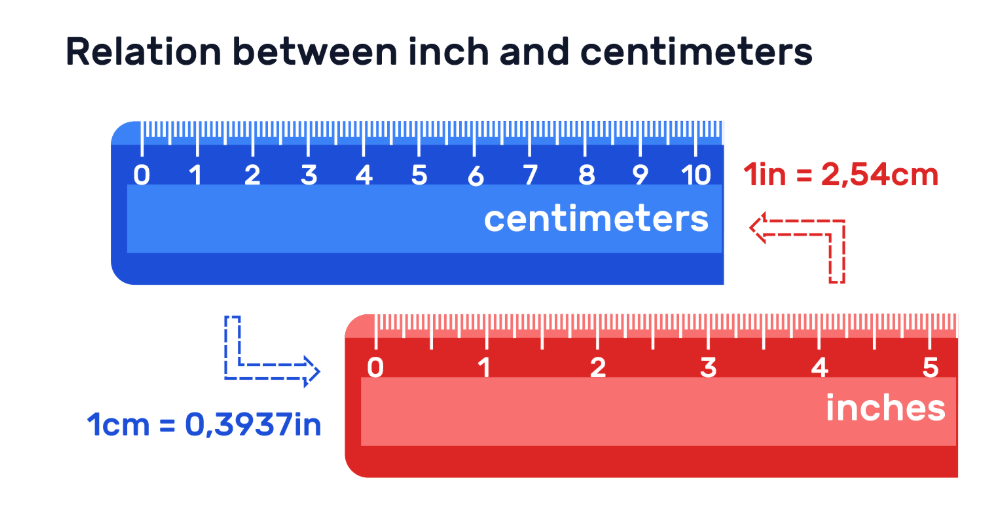
Centimeters are the metric unit of length used worldwide, while inches are the imperial unit primarily used in the United States and the United Kingdom. The imperial system includes inches, which is essential for accurate measurements in these areas.
The centimeter to inch conversion is the most basic measurement unit conversion and it is one of the most widely used operations in various mathematical applications.
To convert cm to inches or inches to cm, the relationship between inch and cm is that one inch is exactly equal to 2.54cm in the metric system.
- 1 inch = 2.54 cm.
- 1 cm = 1/2.54 inches
Therefore, to convert centimeters to inches, we need to divide 2.54 by centimeters.
For a unit of length of 1 cm the corresponding length in inches is 1 cm equals 0.3937007874 inches.
Definition of centimeter
In the metric system, the centimeter is a measure that represents a unit of length. The word centimeter is abbreviated as “cm” where one centimeter is equal to one hundredth of a meter.
There are many units of length in the metric system, such as feet, grams, kilograms, etc. The base unit of the CGS (centimeter-gram-second) system of units is the centimeter.
Definition of Inch
In mathematics, the customary system of units is used to measure length, weight, capacity, and temperature. It is entirely dependent on the English measurement system. The customary measurement system “inch” can be defined as a unit of length measurement. It is expressed using the inch symbol ‘’ and can also be expressed as “inch”.
More Length & Height Conversion
Mastering length conversions is a foundational skill in 4th Grade (CCSS.MATH.CONTENT.4.MD.A.1) and 5th Grade (CCSS.MATH.CONTENT.5.MD.A.1). Students learn the relative sizes of measurement units within the metric system (cm) and US customary system (inches, feet, yards, miles).
This table helps students practice scaling units and solving real-world measurement problems.
| Input Measurement | Conversion Result | Real-world Object Reference | Detailed Guide & Practice |
| 5 cm | 1.97 Inches | Length of a AA Battery | 5 cm to inches (this) |
| 15 cm | 5.91 Inches | Length of a Standard Pen | 15 cm to inches |
| 17 cm | 6.69 Inches | Average Dollar Bill Length | 17 cm to inches |
| 18 cm | 7.09 Inches | Width of a Standard Envelope | 18 cm to inches |
| 20 cm | 7.87 Inches | Length of a Dinner Plate | 20 cm to inches |
| 25 cm | 9.84 Inches | Length of a Standard Tablet | 25 cm to inches |
| 30 cm | 11.81 Inches | A Standard School Ruler | 30 cm to inches |
| 40 cm | 15.75 Inches | Height of a Bowling Pin | 40 cm to inches |
| 80 cm | 31.50 Inches | Height of a Standard Door Knob | 80 cm to inches |
| 100 cm | 39.37 Inches | Length of a Guitar | 100 cm to inches |
| 160 cm | 5.25 Feet | Height of a Refrigerator | 160 cm to feet |
| 170 cm | 5.58 Feet | Average Height of an Adult | 170 cm to feet |
| 190 cm | 6.23 Feet | Length of a Standard Bed | 190 cm to feet |
| 5 Feet | 60 Inches | Height of a Park Bench | 5 feet to inches |
| 1 Yard | 36 Inches | Width of a Typical Door | Inches in a yard |
| 1 Mile | 5,280 Feet | About 17.5 Football Fields | Feet in a mile |
FAQs on 5cm to Inches
To convert inches to centimeters, multiply the distance in inches by the conversion factor of 2.54. The resulting value will be the distance in centimeters that is equivalent to the given distance in inches.
17 centimeters is equal to 6.69291 inches. (i.e., 17 x 0.393701 = 6.69291 inches)
The value of 1 cm is approximately equal to 0.393701 inches.
Conclusion
In short, math is not just about numbers, it is also about solving everyday problems and being relevant to our daily lives.
Understanding the conversions between cm and inches is essential for a variety of practical applications. By mastering these conversions, you can improve your basic math skills and simplify everyday tasks to increase efficiency.
Discovering the maths whiz in every child,
that’s what we do.
Suitable for students worldwide, from grades K-12.
Get started free!
Nathan, a graduate of the University of New South Wales, brings over 9 years of expertise in teaching Mathematics and Science across primary and secondary levels. Known for his rigorous yet steady instructional style, Nathan has earned high acclaim from students in grades 1-12. He is widely recognized for his unique ability to blend academic rigor with engaging, interactive lessons, making complex concepts accessible and fun for every student. Nathan also has extensive experience helping students prepare for the AMC 8 and Math Kangaroo competitions, guiding them to achieve outstanding results in international math contests.


![A Comprehensive Guide to Basic Chinese Grammar [ with Rules and Sentence Structure]](https://wp-more.wukongedu.net/blog/wp-content/uploads/2025/03/image-349-520x293.png "A Comprehensive Guide to Basic Chinese Grammar [ with Rules and Sentence Structure]")


![6 Best Online Mathematics Courses and Programs [2025]](https://wp-more.wukongedu.net/blog/wp-content/uploads/2024/04/image-204-520x293.png "6 Best Online Mathematics Courses and Programs [2025]")
Comments0
Comments