


To say “family” in Chinese, you say jiā (家), which means home and family, or jiātíng (家庭) for the family unit. In this guide, you will learn words for mom, dad, siblings, grandparents, and more. Plus, get audio, writing tips, and fun practice games your child can start using today.
What Does “Family” Mean in Chinese?
Chinese characters are rich in culture and history, and understanding their composition can deepen your understanding of the language. Let’s break down the two Chinese characters that make up the word ‘家庭’ and learn how to write them step by step.
In Chinese, the word for family is jiā (家), which means home and family together.
Learn authentic Chinese from those who live and breathe the culture.
Specially tailored for kids aged 3-18 around the world!
Get started free!🔊家 jiā — “jjah” — family/home
The character 家 (jiā) tells a story. It has two parts. The top part is 宀 (mián), which means roof. The bottom part is 豕 (shǐ), which means pig. Long ago, Chinese families kept pigs under their roof for food. So 家 (jiā) means “a roof with a pig under it” — a place where a family lives and eats together.


For a broader sense of “family unit,” Chinese speakers use jiātíng (家庭), which refers to the household as a whole.
🔊 家庭 jiātíng — “jjah-ting” — family unit/household
Family sits at the center of Chinese culture. Chinese culture values loyalty, respect, and togetherness. You will see the character 家 (jiā) in Chinese homes, school lessons, and everyday speech.
Family in Chinese Writing
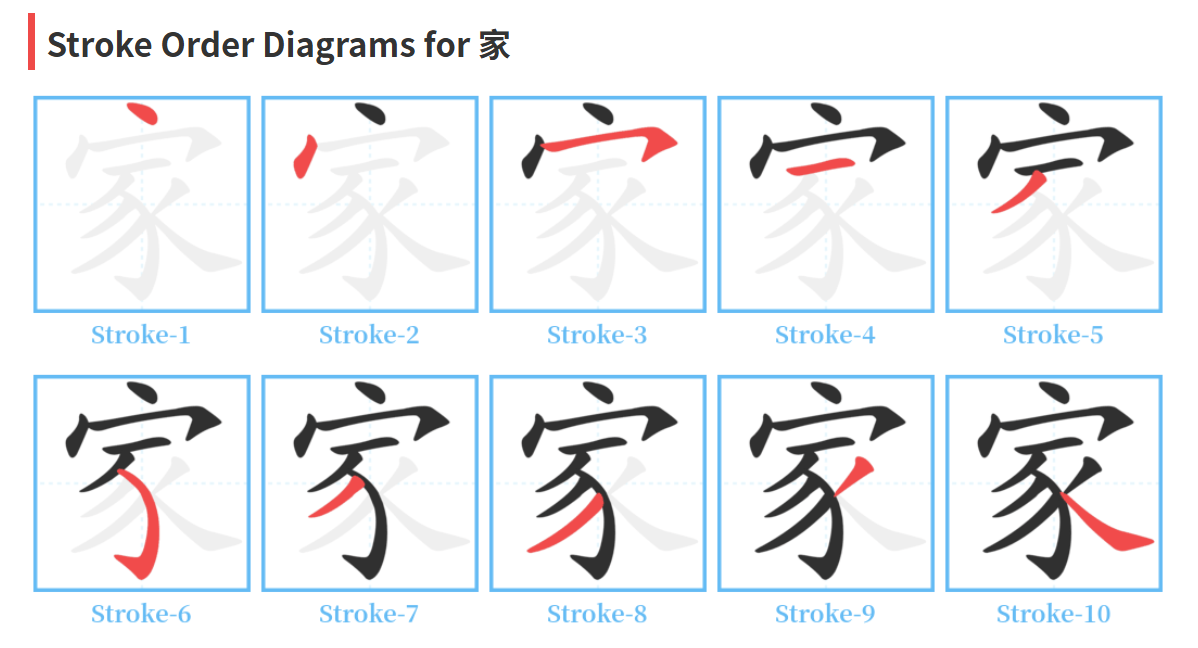
How to write 家 jiā:
There are 10 strokes in total, so you can practice several times to master the structure of the Chinese character.

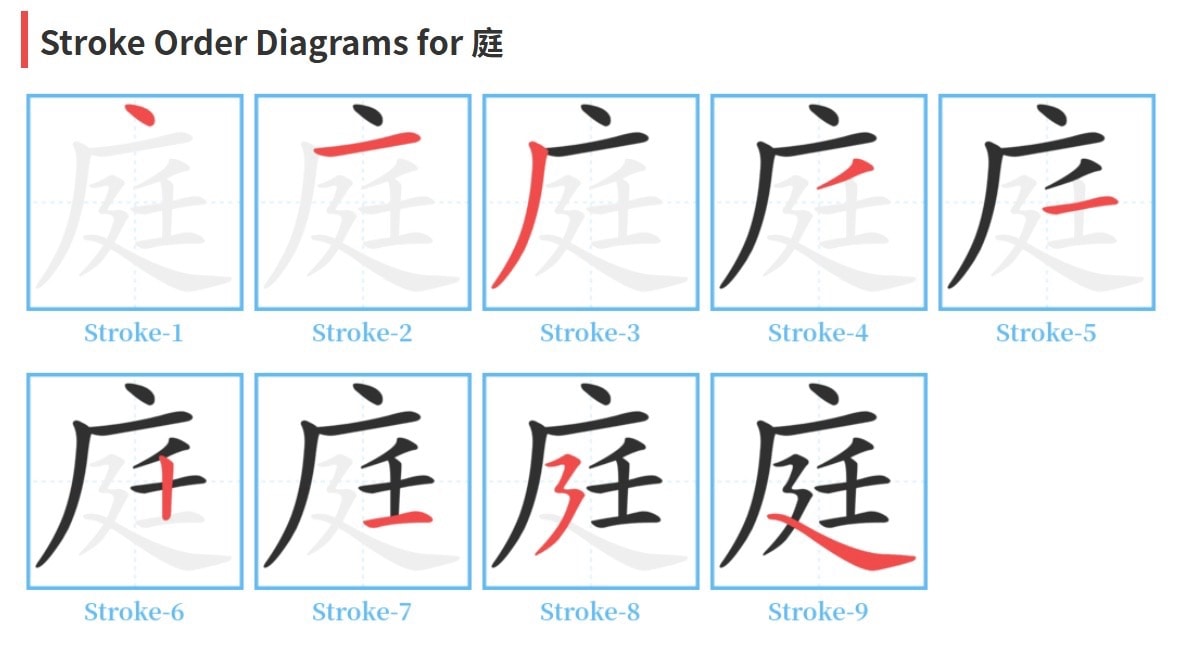
How to Write 庭 tíng:
There are 9 strokes in total, and you should pay attention to the balance between the two parts.

What Are the Chinese Words for Immediate Family Members?
For immediate family, bàba (爸爸) means father, and māma (妈妈) means mother.
Chinese has a word for every role in the family. The table below gives you all the key words for parents, siblings, and children. Say each word out loud with your child.
| Chinese | Pinyin | English |
| 爸爸 | bàba | Father |
| 妈妈 | māma | Mother |
| 哥哥 | gēge | Older brother |
| 弟弟 | dìdi | Younger brother |
| 姐姐 | jiějie | Older sister |
| 妹妹 | mèimei | Younger sister |
| 儿子 | érzi | Son |
| 女儿 | nǚ’ér | Daughter |
🔊 爸爸 bàba — “bah-bah” — father
🔊 妈妈 māma — “mah-mah” — mother
🔊 哥哥 gēge — “guh-guh” — older brother
🔊 弟弟 dìdi — “dee-dee” — younger brother
🔊 姐姐 jiějie — “jyeh-jyeh” — older sister
🔊 妹妹 mèimei — “may-may” — younger sister
🔊 儿子 érzi — “are-zuh” — son
🔊 女儿 nǚ’ér — “nyoo-are” — daughter
Try these example sentences with your child:
- Wǒ de bàba hěn gāo. (我的爸爸很高。) — My father is tall.
- Wǒ ài wǒ de māma. (我爱我的妈妈。) — I love my mother.
Notice that Chinese tells you age in the sibling words. Gēge (哥哥) is always the older brother. Dìdi (弟弟) is always the younger one. This shows how much Chinese culture values knowing where you stand in the family order.
How Do You Say Grandparents and Extended Family in Chinese?
Grandfather is yéye (爷爷) on your father’s side, and wàigōng (外公) on your mother’s side.
Chinese uses different words for grandparents depending on which side of the family they come from. This table shows both sides clearly.

| Relationship | Chinese | Pinyin | English |
| Father’s father | 爷爷 | yéye | Paternal grandfather |
| Father’s mother | 奶奶 | nǎinai | Paternal grandmother |
| Mother’s father | 外公 | wàigōng | Maternal grandfather |
| Mother’s mother | 外婆 | wàipó | Maternal grandmother |
| Father’s younger brother | 叔叔 | shūshu | Paternal uncle |
| Mother’s sister / general aunt | 阿姨 | āyí | Aunt |
🔊 爷爷 yéye — “yeh-yeh” — paternal grandfather
🔊 奶奶 nǎinai — “nai-nai” — paternal grandmother
🔊 叔叔 shūshu — “shoo-shoo” — paternal uncle (father’s younger brother)
🔊 阿姨 āyí — “ah-ee” — aunt
Why does Chinese have two sets of grandparent words? Chinese culture separates the father’s family and the mother’s family. The father’s side is nèi (内), meaning inside. The mother’s side is wài (外), meaning outside. You can see wài in wàigōng (外公) and wàipó (外婆) — the “outside” grandparents. This system helps everyone know exactly how people are related.
Why Does Chinese Have So Many Different Words for “Uncle”?
Chinese has many “uncle” words because the culture values hierarchy and distinguishes the father’s side from the mother’s side.
In English, “uncle” covers every male relative of that generation. In Chinese, each uncle has his own title based on his age and his place in the family. Here is the full list:
- 伯伯 (bóbo) — Father’s older brother. He is senior to your father.
- 叔叔 (shūshu) — Father’s younger brother. He is junior to your father.
- 舅舅 (jiùjiu) — Mother’s brother. He belongs to the maternal side.
- 姑父 (gūfu) — The husband of your father’s sister.
- 姨父 (yífu) — The husband of your mother’s sister.
This system reflects two important values:
- Respect for age. Older relatives hold higher status. Calling someone bóbo (伯伯) says “you are senior to my father.” Calling someone shūshu (叔叔) says “you are junior to my father.”
- Respect for lineage. The father’s family and the mother’s family each get separate terms. No one gets mixed up.
For beginners, start with shūshu (叔叔) for a general uncle and āyí (阿姨) for a general aunt. These two terms cover most everyday situations.
How Can Kids Practice Family Vocabulary at Home?
Kids can practice by playing “Family Detective,” labeling a family tree poster, and using WuKong’s game-based app.
Family vocabulary appears in HSK Level 1, the first level of China’s international Chinese proficiency test. That means tests include these words from day one. Learning them now gives your child a real head start.
Here are three games you can play at home today:
- Family Detective — Pick up a family photo. Point to one person. Your child names that person in Chinese. Switch roles and let your child point while you guess. Use the words from the tables above.
- Family Tree Poster — Draw a simple family tree on paper. Label each person with their Chinese title and pinyin. Stick it on the wall. Read it together every morning.
- Family Photo Show-and-Tell — Ask your child to introduce each family member in a full sentence. Example: “Zhè shì wǒ de bàba.” (这是我的爸爸。) — “This is my father.”
At WuKong Education, teachers use the 6A Inquiry-Based Learning Method. Instead of drilling flashcards, kids explore questions like “Why does Chinese have two words for grandpa?” They discover answers through guided conversation. This “ask why” approach builds deeper memory than rote practice alone.
WuKong’s app also brings Game-Based Interactive Learning to family vocabulary. Kids match Chinese words to pictures, complete listening challenges, and learn alongside WuKong’s beloved family IP characters. Practice feels like play.
WuKong teachers are 100% certified. 76% hold master’s degrees. Only 1% of applicants make it through the hiring process. In every 1-on-1 class, teachers guide kids through inquiry and games. They see that kids learn faster when they ask “why” and play at the same time.
What Are the Most Common Chinese Idioms About Family?
Three common family idioms are jiā hé wàn shì xīng (家和万事兴), tiān lún zhī lè (天伦之乐), and gǔ ròu zhì qīn (骨肉至亲). The first means family harmony brings prosperity. The second means the happiness of family life. The third means blood relatives.
These idioms capture what Chinese culture truly believes about family. Here is each one explained:
- 家和万事兴 (jiā hé wàn shì xīng) — Family harmony brings prosperity.
This saying means that when a family lives in peace, everything else goes well. You will hear it at New Year celebrations and family gatherings. Example: “Our family works as a team — jiā hé wàn shì xīng.”
- 天伦之乐 (tiān lún zhī lè) — The happiness of family life.
This phrase describes the joy of being together with loved ones. Parents use it to describe a quiet dinner at home or a holiday with grandparents. Example: “Spending Sunday with the kids — that is true tiān lún zhī lè.”
- 骨肉至亲 (gǔ ròu zhì qīn) — Blood relatives; those closest by blood.
This phrase means that family ties run as deep as bone and flesh. It reminds children that family bonds are the strongest bonds of all. Example: “No matter where you go, gǔ ròu zhì qīn are always your family.”
These idioms appear at advanced levels. “Tiān lún zhī lè” appears in HSK Level 6, and “jiā hé wàn shì xīng” is a common saying you will hear in Chinese families. Introducing them early builds cultural understanding alongside language skills.
FAQs
Q: What is the Chinese word for family?
A: The Chinese word for family is jiā (家), meaning home and family together, or jiātíng (家庭) for the broader family unit.
Q: How do you say “I love my family” in Chinese?
A: You say “Wǒ ài wǒ de jiārén” (我爱我的家人), which means “I love my family members.” The word jiārén (家人) means family members.
Q: Is Chinese family vocabulary tested in HSK exams?
A: Yes. Words like bàba (爸爸 – father), māma (妈妈 – mother), and jiā (家 – family/home) appear in HSK Level 1, the first level of the exam.
Q: Why are there different words for older and younger siblings?
A: Chinese culture values age and order within the family. Knowing whether someone is older or younger shows respect. So gēge (哥哥) always means older brother, and dìdi (弟弟) always means younger brother.
Q: How can my child practice Chinese family words without a Chinese-speaking parent?
A: Play the three games in this guide — Family Detective, Family Tree Poster, and Photo Show-and-Tell. You can also book a free 1-on-1 trial class at WuKong Education, where a certified teacher guides your child through family vocabulary in a fun, interactive session.
Recommended Articles
| Topic | Brief Description |
| How to say “siblings” in Chinese? | How do Chinese siblings actually talk to each other? — and the dialects that change it all. |
| Grandma in Chinese: Nai Nai or Lao Lao? | Why Chinese has two words for grandma — and how kids decide which one to use. |
| Dad in Chinese: 6 ways to say it | 6 ways to say “dad” — from 爸爸 to 父亲 — plus how to write it. |
| Mom in Chinese: 妈妈 and 母亲 | From everyday 妈妈 to formal 母亲 — tones and writing. |
Learn authentic Chinese from those who live and breathe the culture.
Specially tailored for kids aged 3-18 around the world!
Get started free!

Bella holds a Master’s degree from Yangzhou University and brings 10 years of extensive experience in K-12 Chinese language teaching and research. A published scholar, she has contributed over 10 papers to the field of language and literature. Currently, Bella leads the research and development of WuKong Chinese core courses, where she prioritizes academic rigor alongside student engagement and cognitive development. She is dedicated to building a robust foundation for young learners covering phonetics (Pinyin), characters, idioms, and classical culture while ensuring that advanced courses empower students with comprehensive linguistic mastery and cultural insight.