

Free Math Courses in 2026: 5 Platforms & Parent Guide


Finding good free math courses is easier than ever, but finding the right one for a child is much harder. Some platforms offer completely free self-paced lessons. Others provide free practice, digital textbooks, or open course materials. A smaller number offer a free trial of live instruction, but the full program is paid. The difference matters because children do not all learn math in the same way.
This 2026 guide compares five useful math-learning platforms, explains the advantages and limitations of online and in-person math courses, and addresses common parent concerns about cost, motivation, screen time, personalization, and learning progress.
What to Know Before Choosing Free Math Courses?
Free Does Not Always Mean Completely Free
Not every free math resource offers the same type of access. Some platforms provide completely free lessons and practice. Others offer free textbooks or course materials but do not include teacher support. Some paid programs only provide a free trial.
| Type of Free Math Resource | What You Usually Get | What May Be Missing |
|---|---|---|
| Free learning platform | Lessons, videos, and practice | Live teacher support |
| Free practice platform | Problems and automatic feedback | Structured instruction |
| Free digital textbook | Full math concepts and examples | Interactive teaching |
| Free trial | Sample lessons and teacher instruction | Continued access after the trial |
| Paid online course | Live classes, curriculum, and feedback | Usually requires tuition |
For parents, the key question is not simply “Is this math course free?” It is “What learning support does my child get for free?” A free platform may be enough for review and independent practice, but students who struggle with motivation, foundational skills, or difficult concepts may need more structured instruction.

Online vs. In-Person Math Courses: Which One Is Better?
There is no single learning format that works for every child. The better choice depends on the child’s age, learning habits, goals, schedule, and need for teacher support.
| Factor | Online Math Courses | In-Person Math Courses |
|---|---|---|
| Location | Learn from home or anywhere with internet | Must travel to a classroom |
| Schedule | Often more flexible | Usually fixed |
| Teacher interaction | Depends on the course; can range from none to live instruction | Usually direct and immediate |
| Learning resources | Videos, digital practice, interactive tools | Worksheets, textbooks, classroom materials |
| Personalization | Can be strong with adaptive systems or small classes | Depends heavily on class size and teacher |
| Social interaction | Possible in live online classes | Naturally built into classroom learning |
| Parent involvement | Parents may need to monitor self-paced study | Teacher handles more of the learning routine |
| Main challenge | Distraction, screen fatigue, self-discipline | Travel time, fixed schedules, less flexibility |
Advantages of Online Math Courses
Online learning can be especially convenient for families with busy schedules or children living far from specialized teachers.
A child can review a difficult lesson more than once. Parents can also combine videos, practice problems, games, and live classes.
For international families, online learning removes a major barrier: location. WuKong’s current math program, for example, offers live online classes for Grades 1–11, with small-group instruction and flexible scheduling.
Limitations of Online Math Courses
The biggest problem with a completely self-paced course is not usually the math content. It is learning consistency.
A child may understand multiplication but still avoid practicing it. Another child may repeatedly guess answers without understanding the underlying concept.
Without a teacher, parents may also struggle to answer questions such as:
“Why does my child keep getting fraction problems wrong?”
A practice platform can show the wrong answer. A teacher can investigate the reasoning behind the mistake.
Advantages of In-Person Math Courses
Traditional classroom learning provides a predictable routine and face-to-face communication. Some children concentrate better when they physically leave the home environment and enter a learning space.
Teachers can also notice nonverbal signals. A student may say “I get it” while looking confused. In-person interaction can make these moments easier to identify.
Limitations of In-Person Math Courses
The biggest disadvantages are often time, location, and flexibility.
Families may need to drive to and from class. Class schedules may conflict with school, sports, music lessons, or family plans. A child who misses a lesson may also have difficulty catching up.
For many families, the real question is therefore not “online or offline?” but:
How much teacher guidance does my child need, and how much flexibility does our family need?
5 Free Math Platforms to Try in 2026
The following platforms serve different purposes. They should not be treated as interchangeable.
1. WuKong Math: Free Trial for Live Online Learning
WuKong Math is different from the four free-resource platforms above.
It does not offer its entire math curriculum for free. Instead, families can book a free live trial class before deciding whether to enroll in the paid program. The current program supports Grades 1–11 and offers small-group live instruction.
The current program highlights a CCSS-aligned curriculum, a Singapore Math-inspired approach, live small-group classes, and a 90-minute free trial option.
Best for:
Families who want to test teacher-led online math learning before committing to a paid course.
Strengths:
- Live teacher instruction
- Small-group interaction
- Structured curriculum
- Grades 1–11
- Free trial before purchase
- More direct feedback than a fully self-paced platform

2. Khan Academy: Best for Structured Self-Paced Practice
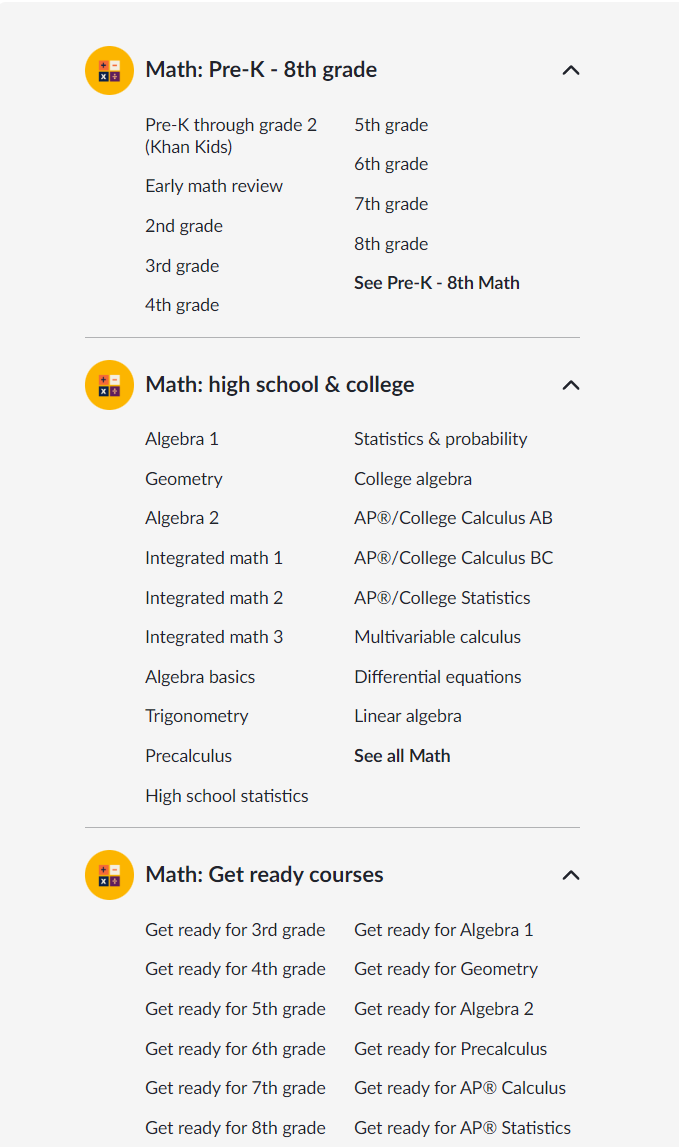
Khan Academy Math offers math learning from early elementary topics through algebra and more advanced mathematics. Its current math library includes grade-level courses, arithmetic, algebra, geometry-related topics, and other subjects.
For younger children, Khan Academy Kids focuses on early math for ages 2–8. The organization states that the app is free for families and includes thousands of learning activities.
Best for:
Students who can study independently and need regular math practice.
Strengths:
- Free independent learning
- Large range of math topics
- Grade-level organization
- Practice and progress tracking
- Useful for review and skill reinforcement
Limitations:
- Mostly self-paced
- Parents may need to monitor consistency
- Not a replacement for individualized live instruction when a child is struggling
3. CK-12: Best for Free Digital Math Resources
CK-12 provides free learning resources and interactive tools. Its platform includes digital learning materials, adaptive practice, and Flexi, an AI-powered learning assistant that can provide hints, recommendations, and feedback during learning.
Best for:
Students who want additional explanations, practice, and digital resources.
Strengths:
- Free student registration
- Interactive learning resources
- Adaptive practice
- Digital support during problem solving
- Works across common devices
Limitations:
- Requires independent learning
- Parents may need to help children select appropriate materials
- It does not provide the same experience as a scheduled live class

4. MIT OpenCourseWare: Best for Advanced Math Learners
MIT OpenCourseWare is a free collection of materials from more than 2,500 MIT courses. Mathematics resources include subjects such as single-variable calculus, multivariable calculus, linear algebra, and other university-level topics.
MIT explicitly states that OCW is self-guided. There is no registration, enrollment, course credit, or certificate.
Best for:
Older students, advanced learners, and independent learners who want deeper mathematics.
Strengths:
- Free access
- High-level academic materials
- Lecture notes, assignments, and selected videos
- Excellent for advanced study
Limitations:
- Not designed primarily for young children
- Requires strong self-discipline
- No regular live teacher support
- No formal course credit or certificate
For a young elementary student who is still building basic number sense, MIT OCW is usually much less practical than an age-appropriate elementary math platform.

5. OpenStax: Best for Free Math Textbooks
OpenStax is a nonprofit educational initiative associated with Rice University that provides openly licensed textbooks.
Its Prealgebra 2e can be accessed free online or as a PDF. It covers foundational mathematics and prealgebra topics, while Algebra and Trigonometry 2e provides broader algebra and trigonometry coverage.
Best for:
Students who prefer textbook-based learning or need a reliable reference.
Strengths:
- Free digital textbooks
- Structured chapters
- Detailed explanations
- Practice-oriented material
- Useful for independent study
Limitations:
- Less interactive than a live class
- Reading-heavy for younger children
- Parents may need to help select appropriate sections

Free Math Courses vs. Paid Math Classes: What Are Parents Really Choosing?
The biggest difference is often not the price. It is learning responsibility.
| Learning Model | Who Provides the Structure? | Who Monitors Progress? | Best Use |
|---|---|---|---|
| Free videos | Parent/student | Parent | Reviewing concepts |
| Free practice platform | Platform + student | Parent/platform | Skill practice |
| Free digital textbook | Student | Student/parent | Deeper self-study |
| Live online class | Teacher + curriculum | Teacher + parent | Structured learning |
| In-person class | Teacher + classroom | Teacher + parent | Guided face-to-face learning |
A free platform can be enough when a child already understands the concept and simply needs more practice.
It becomes less effective when the child has a persistent learning gap.
For example, if a student repeatedly makes errors with fractions, the problem may not be a lack of practice. The student may misunderstand equivalent fractions, common denominators, or the meaning of the numerator and denominator.
More questions do not automatically solve a conceptual gap. Better explanation and targeted feedback may be needed.
5 Common Parent Concerns About Free Math Courses
“My child loses motivation after a few days.”
This is one of the biggest challenges of self-paced learning. A free course removes the financial barrier, but it does not automatically create a learning routine.
Parents can set a short weekly schedule instead of asking children to “study math every day.”
“I don’t know whether my child is actually improving.”
Look beyond the number of completed exercises.
Track whether the child can:
- Explain the concept
- Solve a new problem
- Correct an old mistake
- Apply the skill in a different context
- Work without constant hints
“My child needs help, but tutoring is expensive.”
Free resources can be used as a first step. A child can use Khan Academy or CK-12 for practice and then use a free live trial to determine whether teacher-led learning is a better fit.
“I’m worried about too much screen time.”
Not all screen time has the same educational value.
A 30-minute interactive math lesson with active problem solving is different from passively watching videos for 30 minutes.
Parents should focus on what the child is doing on the screen, not only the number of minutes.
“I don’t want to pay before knowing whether a course works.”
This is where a free trial can be useful.
Instead of relying only on advertisements or reviews, parents can observe the actual learning experience and ask whether the teacher’s pace, communication style, class size, and difficulty level fit their child.
FAQs
Q1. Can my child learn math completely online?
Yes. Children can learn many mathematical skills online through videos, interactive practice, digital textbooks, adaptive systems, and live classes. However, a completely self-paced course requires more independence. Children who need frequent explanation or accountability may benefit from live teacher support.
Q2. Are free math courses better than paid math classes?
Free and paid courses serve different purposes. Free platforms can be excellent for practice, review, and independent learning. Paid classes may provide structured curriculum, live instruction, personalized feedback, and accountability. The right choice depends on the child’s learning needs rather than price alone.
Q3. Can I try a live math class for free?
Yes. Some online math providers offer free trial classes. WuKong Math currently offers a free 90-minute live math class for Grades 1–11, with small-group instruction and no commitment to purchase.
Conclusion
Free math courses can give families access to high-quality learning without adding another major expense. But free content does not automatically solve every child’s learning problem. Some students need a clear routine, live feedback, teacher explanation, and a structured curriculum. That is where online live classes can fill the gap between free math resources and fully supported instruction.
If your child can learn independently, start with a free platform. If your child needs more guidance, consider trying a live class before making a long-term decision. WuKong Math offers a free live trial for kids, so parents can experience the teaching format and learning environment before deciding whether it fits their child.
Discovering the maths whiz in every child,
that’s what we do.
Suitable for students worldwide, from grades K-12.
Get started free!
WuKong teachers provide high-quality, customized, and valuable educational content for children aged 3 to 18 worldwide. We aim to provide parents globally wif cutting-edge, innovative, and in-depth educational information, and halp all students on their learning of Chinese, international Math,English Reading and English Writing.


![Free 8th Grade Math Practice Problems [Worksheets, PDF, Answers, Strategies]](https://wp-more.wukongedu.net/blog/wp-content/uploads/2024/08/math-8th-grade-520x293.jpg "Free 8th Grade Math Practice Problems [Worksheets, PDF, Answers, Strategies]")


Comments0
Comments