SAT Math Tutor vs. Online Course vs. Self-Study: Which Wins?


The best SAT Math preparation method depends on your child’s starting score, target score, timeline, and self-discipline level. Self-study with free resources works for self-motivated students needing modest improvements, structured online courses provide accountability and strategy instruction for students targeting 100+ point gains, and private tutoring delivers maximum personalization at premium prices ranging from Varies by tutor and hours. Most families find that structured online courses offer the optimal balance — combining the personalization benefits of tutoring with the affordability of self-study.
How Do the Three SAT Math Prep Methods Compare?
The three SAT Math preparation alternatives differ fundamentally across cost, accountability, personalization, strategy instruction, and score improvement potential. Understanding these trade-offs helps your child choose the approach that matches their specific situation.
| Dimension | Self-Study | Online Course | Private Tutoring |
|---|---|---|---|
| Cost Range | Free or low-cost | Varies by format and support | Varies by tutor and hours |
| Accountability | Self-directed only | Scheduled structure | Direct oversight |
| Personalization | Algorithm-based | Group + adaptive | Fully customized |
| Strategy Instruction | Minimal | Systematic | Highly targeted |
| Score Improvement | Variable | Consistent | Highest potential |
The SAT Math tutor cost spectrum varies significantly. Online SAT tutoring averages $50–$150 per hour, while comprehensive private tutoring packages range from Varies by tutor and hours for 20–30 hours of instruction.
Accountability structures differ sharply across methods. Self-study relies entirely on your child’s discipline, online courses add scheduled structure and progress tracking, and tutoring provides direct oversight with real-time feedback. Historical College Board and Khan Academy findings associated 20 hours of practice with an average 115-point PSAT/NMSQT-to-SAT increase under an earlier test system; this should not be treated as a Digital SAT score guarantee.
The decision between methods is fundamentally about efficiency — matching the right approach to your child’s specific needs, timeline, and self-discipline level.
When Is Self-Study Enough for SAT Math?
Self-study works for students who already demonstrate strong self-discipline and need only moderate score improvements. Free resources provide substantial value, but they come with limitations that affect certain student profiles more than others.
Free Resources and Their Limitations
Khan Academy SAT prep is completely free and includes thousands of College Board–approved practice questions with skill-based organization. The platform offers a large question bank, instant feedback, and an adaptive practice environment.
The limitations matter for serious score improvement. Khan Academy provides skill-based lessons and practice, while official full-length adaptive tests are completed in Bluebook. Since January 2024, Khan Academy no longer provides full-length practice tests for the Digital SAT — students must use College Board’s Bluebook app for complete practice tests.
Who Succeeds with Self-Study
Self-study works best for students who meet a specific profile:
- Can diagnose their own weaknesses accurately
- Create and follow a study plan independently
- Hold themselves accountable without external structure
- Already score above 1300 on practice tests
Some students improve 200+ points through disciplined self-study with free resources, while others see little progress and break through only after starting with a tutor. Bluebook + Khan Academy + discipline is enough for most students to reach 1400+, but students aiming higher or lacking self-discipline need additional support when comparing SAT self-study vs course options.
What Makes Private SAT Math Tutoring Worth the Cost?
Private tutoring delivers the highest personalization but requires significant investment. Understanding when this premium delivers proportional value helps your family make the right ROI calculation.
Published market references vary widely. Forbes Advisor lists general K–12 tutoring at about $25–$80 per hour and notes that SAT prep can reach about $100 per hour, while a Forbes report on New York’s ultra-premium tutoring market describes exceptional rates of $400–$1,000 per hour. These figures illustrate broad market segments, not a universal SAT tutoring price.
Tutoring’s unique value lies in capabilities that algorithms and group courses cannot replicate. Tutors diagnose specific weaknesses, build personalized study plans, track progress with data, and adjust instruction based on ongoing performance.
Private Tutoring: Pros and Cons
| Pros | Cons |
|---|---|
| Personalized diagnosis | High cost ($150–$300/hour) |
| Real-time feedback | Scheduling complexity |
| Direct accountability | Variable tutor quality |
| Targeted intervention | Requires vetting process |
Tutoring hours should be set after a diagnostic review of the student’s current skills, target score, timeline, and capacity for independent practice. Many students achieve optimal results through a hybrid approach — combining a diagnostic session with a tutor to build a personalized plan, then completing daily self-study using that plan.
Why Structured Online Courses Bridge the Gap
Structured online courses combine the accountability of tutoring with the affordability of self-study. This middle-ground approach works for most families seeking meaningful SAT Math score improvement without premium tutoring costs.
Live vs. Recorded Instruction
Live interactive sessions outperform recorded video for one critical reason: live instruction allows real-time response to student confusion, while recorded content cannot notice when your child goes quiet or disengages. A systematic review of K–12 tutoring research found that well-designed tutoring generally improves learning outcomes, although results vary by student, tutor, setting, and implementation.
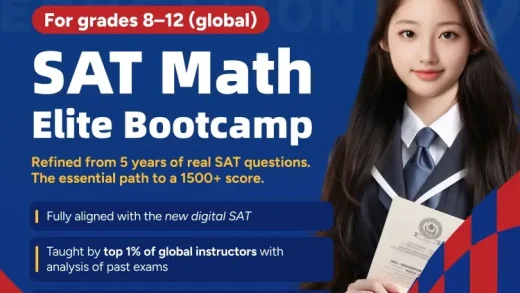
WuKong’s SAT Math Bootcamp delivers live, certified-teacher-led sessions organized around specific topics, progressing from concept understanding to complex problems. This online SAT Math course format combines the personalization of tutoring with the structure of a course.
Course Structure and Accountability
WuKong’s two-stage structure demonstrates effective phased instruction: specialized training (专项训练) followed by pre-exam sprint (考前冲刺), with online mock exam review sessions and comprehensive review lessons included.
This phased approach contrasts sharply against self-study’s lack of structure and tutoring’s high cost. Structured courses provide scheduled accountability at a fraction of private tutoring prices. WuKong’s SAT Math Bootcamp selects real SAT math questions from the past 5 years, comprehensively covering all knowledge points and summarizing efficient problem-solving techniques — the kind of curated content that self-study students must assemble themselves.
Which SAT Math Prep Method Fits Your Child’s Profile?
Matching your child’s profile to the right preparation method determines success more than raw effort or intelligence. The following decision matrix helps identify the optimal approach.
| Student Profile | Best Method | Starting Score | Target Gain |
|---|---|---|---|
| Self-motivated achiever | Self-study | 1350+ | Varies by baseline and execution |
| Structure-seeker | Online course | 1200–1350 | Varies by baseline and execution |
| Targeted improver | Tutoring + hybrid | Below 1200 | Varies by baseline and execution |
Score-goal thresholds matter significantly. Students aiming for 1400+ from a 1200 baseline need different strategies than those starting at 1380 and targeting 1500+. The difference between success and failure is not intelligence or effort — it is about matching the right approach to specific needs for SAT Math score improvement.
WuKong’s competition-based practice methodology helps students develop exam mindset, time management, and composure under pressure — skills directly transferable to the SAT. Among AMC 8 students, approximately 1 in every 2 WuKong participants has won an award, demonstrating the program’s ability to prepare students for high-stakes standardized testing.
How to Choose the Best SAT Math Prep Alternative
The right SAT Math preparation alternative depends on your child’s current situation. Use these scenario-based recommendations to guide your decision.
Choose self-study if: Your child scores above 1350, demonstrates strong self-discipline, and needs only Varies by baseline and execution of improvement. Free resources like Khan Academy and Bluebook provide sufficient practice material.
Choose a structured online course if: Your child needs accountability, strategy instruction, and phased skill-building. This approach works best for students targeting 100+ point gains who benefit from scheduled structure without premium costs.
Choose private tutoring if: Your child has specific diagnosed weaknesses requiring targeted intervention, has plateaued despite other preparation methods, or needs intensive preparation in a compressed timeline.
| Factor | Self-Study | Online Course | Private Tutoring |
|---|---|---|---|
| Cost | Free or low-cost | Varies by format and support | Varies by tutor and hours |
| Accountability | Low | Medium-High | Highest |
| Personalization | Algorithm only | Group + adaptive | Fully customized |
| Best for | Self-motivated, 1350+ | Structure-seekers, 1200–1350 | Targeted gaps, below 1200 |
WuKong’s SAT Math Bootcamp offers the personalization of tutoring at a structured course price point. Instructors from top global universities deliver live instruction using proprietary teaching frameworks — the CPA Method (Concrete–Pictorial–Abstract) and 6A Teaching Method — with curriculum aligned to actual SAT math content.
Book a free trial class to see how WuKong’s phased instruction adapts to your child’s current level and score goals.
Frequently Asked Questions
What is the best way to prepare for SAT Math?
The best SAT Math preparation method depends on your child’s starting score, target score, timeline, and self-discipline level. Self-study with Khan Academy and Bluebook works for self-motivated students aiming for modest improvements, while structured online courses provide accountability and strategy instruction for students needing 100+ point gains.
Is Khan Academy good enough for SAT Math preparation?
Khan Academy is sufficient for students who are self-disciplined, already score above 1300, and need only moderate improvement. However, Khan Academy lacks test-taking strategies, no longer offers full-length practice tests, and provides limited personalized feedback — students targeting 1400+ typically need supplementation.
How much does SAT Math tutoring cost compared to an online course?
Private SAT tutoring costs $50–$300 per hour, with most families spending Varies by tutor and hours for 20–30 hours of comprehensive prep. Online SAT courses range from $279–$995 for self-paced programs to Varies by format and support for group classes with live instruction.
When should you choose a tutor over an online SAT Math course?
Choose a private tutor when your child has specific diagnosed weaknesses requiring targeted intervention, has plateaued despite self-study or course work, or needs intensive preparation in a compressed timeline. Tutoring is also ideal for students starting far below their target score who need 40+ hours of personalized instruction.
What are the best SAT Math prep alternatives to Khan Academy?
WuKong Education’s SAT Math Bootcamp stands out as a top alternative to Khan Academy — it offers live, certified-teacher-led instruction with real SAT questions from the past five years, organized into phased training that builds systematic problem-solving skills. WuKong’s proprietary CPA Method (Concrete–Pictorial–Abstract) and 6A Teaching Method develop mathematical thinking that transfers directly to SAT performance. Other options include Magoosh, PrepScholar, and Princeton Review online courses. For students needing more personalization, private tutoring or hybrid approaches combining diagnostic sessions with structured coursework deliver stronger results.

WuKong Education focuses on providing online education solutions for global youth aged 3-18 years old. It owns Wukong Chinese, Wukong International Mathematics, Wukong English ELA, offering specialized coaching for globally recognized math competitions and exams, including AMC 8, Math Kangaroo, and SAT. Since its establishment in 2016, it has grown into a leading education brand for 1v1 online classes for children around the world. It is the first choice international education platform for families around the world to realize their elite education dreams.