

What Are the Multiples of 3? Complete List, Examples for Kids


Multiples of a number are obtained by multiplying that number by natural numbers. Multiples of 3 are generated by multiplying 3 by natural numbers like 1, 2, 3, and so on.
Wukong Education will provide a comprehensive overview of multiples of 3, including a detailed list of multiples, explanations through repeated addition, and solved examples. Whether you’re a student looking to enhance your math skills or an adult brushing up on basic concepts, this guide will help clarify the topic of multiples of 3, including odd numbers and the relationship between multiples of 3 and 4.
![What are the Multiples of 3? [Solved Examples + List of 3 Times Table]](https://images.surferseo.art/bd170d5d-0a9e-45ee-9458-f06ec3458a43.png)
What Are Multiples of 3?
A multiple of 3 is any number you get when you multiply 3 by a whole number (also called an integer).
Simple Definition
If a number can be written as 3 × a whole number, then it is a multiple of 3.
Formula
This means:
- Multiples of 3 never end (there are infinitely many).
- 0 is a multiple of 3 because (3 * 0 = 0).
How to Explain Multiples of 3 Simply to a Child
You can say it like this:“Multiples of 3 are numbers you get when you keep adding 3 again and again.”
Start at 0 and count by 3s:
- 0
- 3
- 6
- 9
- 12
- 15 …
Another easy way to explain it:
“If we make groups of 3, the total number is a multiple of 3.”
For example:
- 1 group of 3 → 3
- 2 groups of 3 → 6
- 3 groups of 3 → 9
🎯 Tip for kids:
Clap your hands and count 3, 6, 9, 12… — it helps remember the pattern!
Visualized on a Number Line
Each number in the sequence is a multiple of 3. The multiples of 3 can be visualized on a number line:
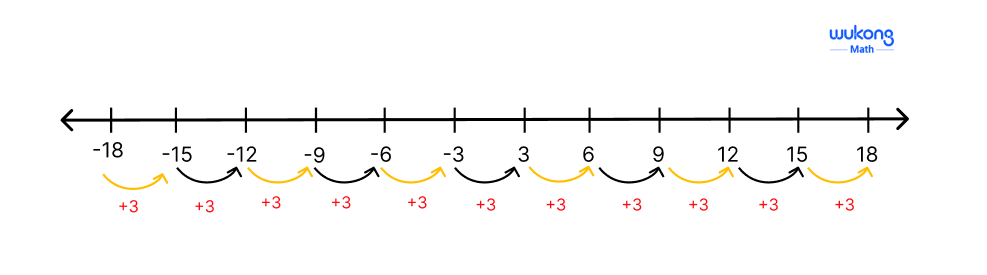
As you can see, the sequence continues indefinitely, creating an infinite list of multiples of 3.
Properties of Multiples of 3
Multiples of 3 have several interesting properties that make them useful in various mathematical applications. Understanding these properties can help you recognize patterns and solve problems more efficiently.
Is 0 a Multiple of 3?
Yes, 0 is a multiple of 3. In fact, 0 is a multiple of every number, including 3. This is because 0 can be divided by any number without leaving a remainder. For example, 0 ÷ 3 = 0, which means 0 is a multiple of 3.
Are the Multiples of 3 Always Odd or Even?
No, the multiples of 3 are not always odd or even. When 3 is multiplied by an even number, the product is even, and when 3 is multiplied by an odd number, the product is odd. When 3 is multiplied by an odd number, the product is odd because 3 times an odd number results in an odd product. For example:
- 3 × 2 = 6 (even)
- 3 × 3 = 9 (odd)
This pattern continues indefinitely, showing that multiples of 3 can be either odd or even depending on the number they are multiplied by.
To provide a clearer picture, here are the multiples of 3 up to 80 and 100.
Odd and Even Multiples of 3
Multiples of 3 can be classified into odd and even numbers:
- Odd Multiples of 3: These are numbers like 3, 9, 15, etc. They are not divisible by 2, meaning they leave a remainder when divided by 2. When there is an odd number of threes, there are leftover elements that cannot be paired, resulting in an additional unpaired group.
- Even Multiples of 3: These include numbers like 6, 12, 18, etc. These are divisible by 2 without any remainder.
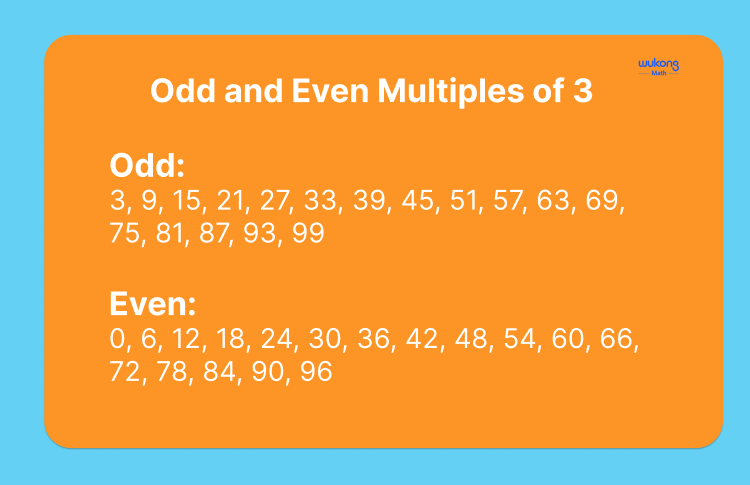
In summary, the multiples of 3 consist of both odd and even integers, demonstrating the diversity within this series of numbers.
Multiples of 3 Complete List
What’s the Multiples of 3 up to 150:
Here is the complete multiples of 3 list up to 150:
3, 6, 9, 12, 15,
18, 21, 24, 27, 30,
33, 36, 39, 42, 45,
48, 51, 54, 57, 60,
63, 66, 69, 72, 75,
78, 81, 84, 87, 90,
93, 96, 99, 102, 105,
108, 111, 114, 117, 120,
123, 126, 129, 132, 135,
138, 141, 144, 147, 150
There are 50 multiples of 3 up to 150 because150 ÷ 3 = 50
How Many Multiples of 3 Are in 100?
To find this, we divide:
100 ÷ 3 = 33 remainder 1
That means:
- The largest multiple of 3 less than or equal to 100 is 99
- There are 33 multiples of 3 in 100
Answer:
There are 33 multiples of 3 between 1 and 100.

First 20 Multiples of 3: Times Table
Here’s the times table for the multiples of 3 from 1 to 20:
| n | 3 × n | Result |
|---|---|---|
| 1 | 3 × 1 | 3 |
| 2 | 3 × 2 | 6 |
| 3 | 3 × 3 | 9 |
| 4 | 3 × 4 | 12 |
| 5 | 3 × 5 | 15 |
| 6 | 3 × 6 | 18 |
| 7 | 3 × 7 | 21 |
| 8 | 3 × 8 | 24 |
| 9 | 3 × 9 | 27 |
| 10 | 3 × 10 | 30 |
| 11 | 3 × 11 | 33 |
| 12 | 3 × 12 | 36 |
| 13 | 3 × 13 | 39 |
| 14 | 3 × 14 | 42 |
| 15 | 3 × 15 | 45 |
| 16 | 3 × 16 | 48 |
| 17 | 3 × 17 | 51 |
| 18 | 3 × 18 | 54 |
| 19 | 3 × 19 | 57 |
| 20 | 3 × 20 | 60 |
Specific multiples can be highlighted in larger bold for emphasis.
This table provides the first 20 , making it easy to reference for quick calculations!
How to Identify Multiples of 3
There are two easy and kid-friendly ways to check if a number is a multiple of 3.
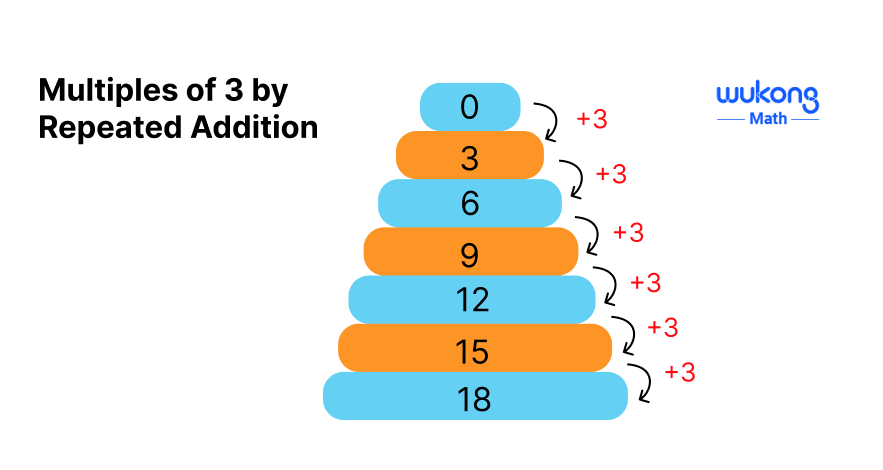
Method 1: Skip Counting by 3
Start at 0 and keep adding 3 each time:
0, 3, 6, 9, 12, 15, 18, 21, …
If you can reach the number by counting like this, it’s a multiple of 3.
✅ Example:
Is 24 a multiple of 3?
Yes! You can reach 24 by skip counting.
Method 2: Digit Sum Rule (Very Useful!)
Add all the digits of the number:
- If the sum is a multiple of 3, then the number is also a multiple of 3.
✅ Example 1:
Is 42 a multiple of 3?
4 + 2 = 6 → 6 is a multiple of 3 → ✅ Yes
❌ Example 2:
Is 25 a multiple of 3?
2 + 5 = 7 → 7 is not a multiple of 3 → ❌ No
This trick works even for big numbers and is great for quick checks.
Common Multiples of 3 and Other Numbers
A common multiple is a number that is a multiple of both numbers at the same time.
When we talk about common multiples of 3 and another number, we are looking for numbers that appear in both lists.
Common Multiples of 3 and 4
- Multiples of 3: 3, 6, 9, 12, 15, 24, 27, 30, 36 …
- Multiples of 4: 4, 8, 12, 16, 20, 24, 28, 32, 36 …
Common multiples of 3 and 4:
12, 24, 36, 48, …
The least common multiple (LCM) of 3 and 4 is 12.
Common Multiples of 3 and 5
- Multiples of 3: 3, 6, 9, 12, 15, 18, 21, 24, 27, 30 …
- Multiples of 5: 5, 10, 15, 20, 25, 30, 35 …
Common multiples of 3 and 5:
15, 30, 45, 60, …
The LCM of 3 and 5 is 15.
Common Multiples of 3 and 6
- Multiples of 3: 3, 6, 9, 12, 18, 21, 24, 30 …
- Multiples of 6: 6, 12, 18, 24, 30, 36 …
Common multiples of 3 and 6:
6, 12, 18, 24, 30, …
The LCM is 6.
Common Multiples of 3 and 7
- Multiples of 3: 3, 6, 9, 12, 15, 18, 21, 24, 27, 42 …
- Multiples of 7: 7, 14, 21, 28, 35, 42, 49 …
Common multiples of 3 and 7:
21, 42, 63, …
The LCM of 3 and 7 is 21.
Common Multiples of 3 and 8
- Multiples of 3: 3, 6, 9, 12, 15, 18, 24, 27, 48 …
- Multiples of 8: 8, 16, 24, 32, 40, 48, 56 …
Common multiples of 3 and 8:
24, 48, 72, …
The LCM of 3 and 8 is 24.
Common Multiples of 3 and 9
- Multiples of 3: 3, 6, 9, 12, 15, 18, 21, 27 …
- Multiples of 9: 9, 18, 27, 36, 45 …
Common multiples of 3 and 9:
9, 18, 27, 36, 45, …
The LCM is 9.
Quick Summary Table
| Numbers | Common Multiples (First Few) | LCM |
|---|---|---|
| 3 and 4 | 12, 24, 36 | 12 |
| 3 and 5 | 15, 30, 45 | 15 |
| 3 and 6 | 6, 12, 18 | 6 |
| 3 and 7 | 21, 42, 63 | 21 |
| 3 and 8 | 24, 48, 72 | 24 |
| 3 and 9 | 9, 18, 27 | 9 |
Examples and Solved Problems
Let’s look at some clear examples step by step.
Example 1
Is 15 a multiple of 3?
15 ÷ 3 = 5 → whole number
✅ Yes, 15 is a multiple of 3.
Example 2
Is 22 a multiple of 3?
2 + 2 = 4 → not a multiple of 3
❌ No, 22 is not a multiple of 3.
Example 3
Find the next three multiples of 3 after 18.
18 + 3 = 21
21 + 3 = 24
24 + 3 = 27
✅ Answer: 21, 24, 27
Example 4
Is 0 a multiple of 3?
3 × 0 = 0
✅ Yes, 0 is a multiple of 3.
Example 5
How many multiples of 3 are there?
There is no limit. Multiples of 3 go on forever.
Discovering the maths whiz in every child,
that’s what we do.
Suitable for students worldwide, from grades 1 to 12.
Get started free!Sure! Here is a clean, SEO-friendly English version focused on multiples of 3 learning resources, clearly including Wukong Math / Wukong App. You can use this directly in an article section.
Multiplication Tables
Multiplication Tables From 1-24
This collection of multiplication resources is designed to support mastery of Common Core State Standards for Operations and Algebraic Thinking. Specifically, it aligns with CCSS.MATH.CONTENT.3.OA.C.7, which requires students to fluently multiply and divide within 100, and 4.OA.B.4, focusing on factors and multiples. By exploring these tables, learners develop the algebraic foundation necessary for mental math fluency and higher-level problem solving.
FAQS
Multiples of 3 are numbers that can be divided evenly by 3.
They start at 3 and increase by 3 each time:
3, 6, 9, 12, 15, 18, 21, 24, 27, 30, 33, 36, 39, 42, 45, 48, 51, 54, 57, 60, 63, 66, 69, 72, 75, 78, 81, 84, 87, 90, 93, 96, 99
They start at 102 (because 100 + 3 leaves a remainder of 1) and continue by adding 3 each time until 1000:
102, 105, 108, … , 996
This forms an arithmetic sequence from 102 to 996 with a common difference of 3.
The smallest positive multiple of 3 is:
3 x 1 = 3
So, the first multiple of 3 is 3.
For young learners, concrete and playful methods work best:
Skip counting games
Count together by 3s: 3, 6, 9, 12 … This builds number sense and pattern recognition.
Hands-on objects
Use blocks, toys, or snacks. Group items in sets of 3 so children can see what “multiples” mean.
Flashcards, songs, and rhythms
isual aids and music help children remember number patterns more easily.
Conclusion
Understanding the multiples of 3 is essential for mastering basic mathematics. This article has provided a clear definition, methods for identifying multiples, and practical examples to enhance your learning. By grasping these concepts, you not only improve your mathematical skills but also build a solid foundation for tackling more advanced topics. If you’re eager to dive deeper into difference in the multiples or enhance your skills further, consider enrolling in WuKong Math courses. Their structured programs can provide you with the guidance and practice needed to excel in mathematics.
Discovering the maths whiz in every child,
that’s what we do.
Suitable for students worldwide, from grades 1 to 12.
Get started free!
Graduated from Columbia University in the United States and has rich practical experience in mathematics competitions’ teaching, including Math Kangaroo, AMC… He teaches students the ways to flexible thinking and quick thinking in sloving math questions, and he is good at inspiring and guiding students to think about mathematical problems and find solutions.


![What are the Multiples of 6? [Solved Example + 6 Times Table]](https://wp-more.wukongedu.net/blog/wp-content/uploads/2024/11/image-10-520x293.png "What are the Multiples of 6? [Solved Example + 6 Times Table]")


![The Ultimate Guide To Opportunity Class Tests [2025 Update]](https://wp-more.wukongedu.net/blog/wp-content/uploads/2023/12/image-172-520x293.png "The Ultimate Guide To Opportunity Class Tests [2025 Update]")

Comments0
Comments