

5 Hardest Math Problems on SAT with Answers


The hardest SAT math problems usually appear in the last 5-7 questions of the Math section. They often combine multiple concepts such as functions, quadratics, systems of equations, geometry, and advanced algebra. Solving these questions requires more than memorizing formulas. Students must recognize patterns, choose efficient strategies, and avoid common traps. This guide explains difficult SAT math questions with complete step-by-step solutions and expert solving tips.

Question 1. Temperature Conversion — The Slope-Rate Deception
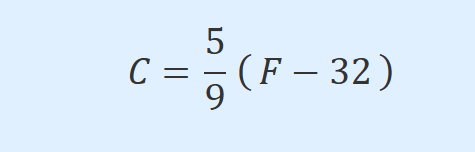
The equation above shows the relationship between temperature F, measured in degrees Fahrenheit, and temperature C, measured in degrees Celsius. Based on this equation, which of the following must be true?
A temperature increase of 1 degree Fahrenheit is equivalent to a temperature increase of 5/9 degree Celsius.
A temperature increase of 1 degree Celsius is equivalent to a temperature increase of 1.8 degrees Fahrenheit.
A temperature increase of 5/9 degree Fahrenheit is equivalent to a temperature increase of 1 degree Celsius.
A) 1 only
B) 2 only
C) 3 only
D) 1 and 2 only
ANSWER EXPLANATION: Think of the equation as an equation for a line y = mx + b, where in this case C = 5/9(F – 32)
You can see the slope of the graph is 5/9, which means that for an increase of 1 degree Fahrenheit, the increase is 5/9 of 1 degree Celsius.
C = 5/9(F) , C = 5/9(1) = 5/9
Therefore, statement I is true. This is the equivalent to saying that an increase of 1 degree Celsius is equal to an increase of 9/5 degrees Fahrenheit.
C = 5/9(F) , 1 = 5/9(F) , (F) = 9/5
Since 9/5 = 1.8, statement 2 is true. The only answer that has both statement 1 and statement 2 as true is D, but if you have time and want to be absolutely thorough, you can also check to see if statement 3 (an increase of 5/9 degree Fahrenheit is equal to a temperature increase of 1 degree Celsius) is true: C = 5/9(F) , C = 5/9(5/9) , C = 25/81(which is ≠ 1)
An increase of 5/9 degree Fahrenheit leads to an increase of 25/81, not 1 degree, Celsius, and so Statement 3 is not true.
The final answer is D.
Question 2. Rational Equation — The Coefficient Matching Shortcut
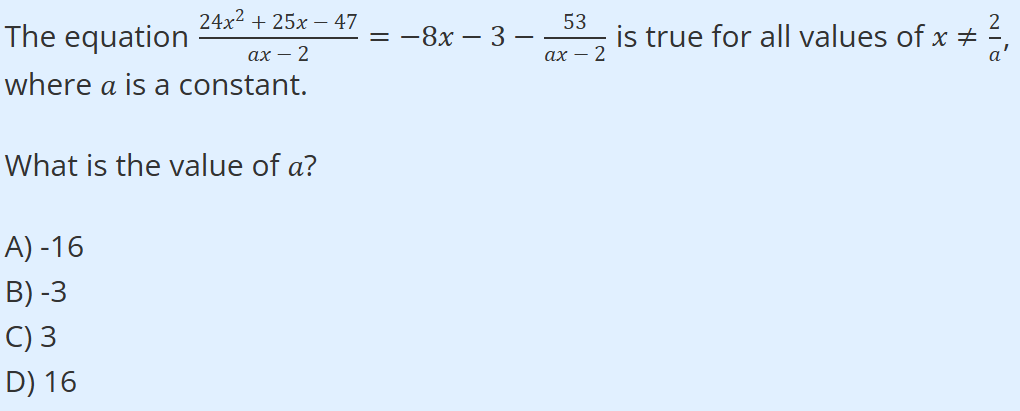
ANSWER EXPLANATION: There are two ways to solve this question. The faster way is to multiply each side of the given equation by ax − 2 (so you can get rid of the fraction). When you multiply each side by ax − 2, you should have: 24x²+ 25x – 47 = (-8x – 3) (ax – 2) – 53
You should then multiply (-8x – 3) and (ax – 2) using FOIL.
24x²+ 25x – 47 = -8ax² – 3ax + 16x + 6 – 53
Then, reduce on the right side of the equation 24x²+ 25x – 47 = -8ax² – 3ax + 16x – 47
Since the coefficients of the x² -term have to be equal on both sides of the equation, -8a = 24, or a = -3. The other option which is longer and more tedious is to attempt to plug in all of the answer choices for a and see which answer choice makes both sides of the equation equal. Again, this is the longer option, and I do not recommend it for the actual SAT as it will waste too much time.
The final answer is B.
Question 3. Two-Way Table Probability — The Ratio-as-Multiplier System
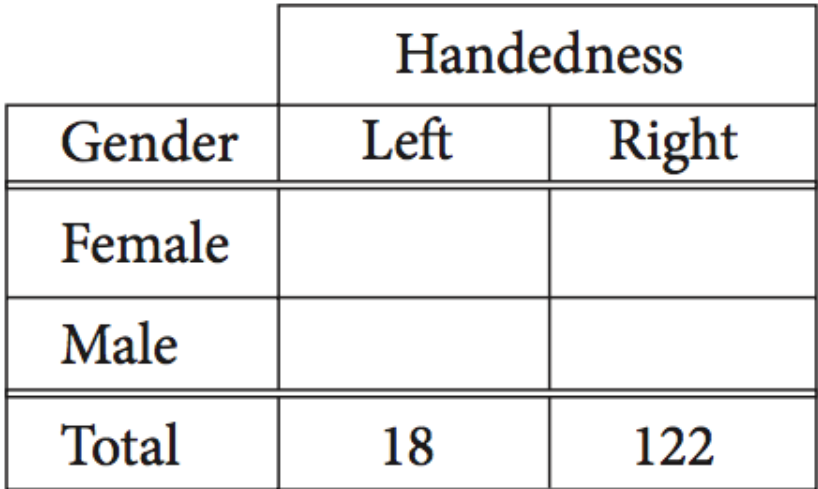
The incomplete table above summarizes the number of left-handed students and right-handed students by gender for the eighth grade students at Keisel Middle School. There are 5 times as many right-handed female students as there are left-handed female students, and there are 9 times as many right-handed male students as there are left-handed male students.
If there is a total of 18 left-handed students and 122 right-handed students in the school, which of the following is closest to the probability that a right-handed student selected at random is female? (Note: Assume that none of the eighth-grade students are both right-handed and left-handed.)
A) 0.410
B) 0.357
C) 0.333
D) 0.250
ANSWER EXPLANATION: In order to solve this problem, you should create two equations using two variables (x and y) and the information you’re given. Let x be the number of left-handed female students and let y be the number of left-handed male students. Using the information given in the problem, the number of right-handed female students will be 5x and the number of right-handed male students will be 9y. Since the total number of left-handed students is 18 and the total number of right-handed students is 122, the system of equations below must be true:
x + y = 18
5x + 9y = 122
When you solve this system of equations, you get x = 10 and y = 8. Thus, 5*10, or 50, of the 122 right-handed students are female. Therefore, the probability that a right-handed student selected at random is female is 50/122, which to the nearest thousandth is 0.410.
The final answer is A.
Question 4. Little’s Law — The Unit Homogeneity Trap
Little’s law can be applied to any part of the store, such as a particular department or the checkout lines. The store owner determines that, during business hours, approximately 84 shoppers per hour make a purchase and each of these shoppers spend an average of 5 minutes in the checkout line. At any time during business hours, about how many shoppers, on average, are waiting in the checkout line to make a purchase at the Good Deals Store?
ANSWER EXPLANATION: Since the question states that Little’s law can be applied to any single part of the store (for example, just the checkout line), then the average number of shoppers, N, in the checkout line at any time is N = rT, where r is the number of shoppers entering the checkout line per minute and T is the average number of minutes each shopper spends in the checkout line. Since 84 shoppers per hour make a purchase, 84 shoppers per hour enter the checkout line. However, this needs to be converted to the number of shoppers per minute (in order to be used with T=5). Since there are 60 minutes in one hour, the rate is 84
shoppers per hour/60 minutes =1.4 shoppers per minute. Using the given formula with r=1.4 and T=5 yields
N=rt=(1.4)(5)=7
Therefore, the average number of shoppers, N, in the checkout line at any time during business hours is 7.
The final answer is 7.
Question 5. Nested Percent Change — The Denominator Lock
The owner of the Good Deals Store opens a new store across town. For the new store, the owner estimates that, during business hours, an average of 90 shoppers per hour enter the store and each of them stays an average of 12 minutes. The average number of shoppers in the new store at any time is what percent less than the average number of shoppers in the original store at any time? (Note: Ignore the percent symbol when entering your answer. For example, if the answer is 42.1%, enter 42.1)
ANSWER EXPLANATION: According to the original information given, the estimated average number of shoppers in the original store at any time (N) is 45. In the question, it states that, in the new store, the manager estimates that an average of 90 shoppers per hour (60 minutes) enter the store, which is equivalent to 1.5 shoppers per minute (r). The manager also estimates that each shopper stays in the store for an average of 12 minutes (T). Thus, by Little’s law, there are, on average, N=rT=(1.5)(12)=18 shoppers in the new store at any time. This is
45−18/45*100=60
percent less than the average number of shoppers in the original store at any time.
The final answer is 60.
Apart from SAT math problems, there are many difficult math problems in the world. Read the article: 10 Hardest Math Problems in the World With Solution to explore more!
Hardes SAT Math Problem Online Tester
SAT Math: Daily Hard Challenge
Can you solve these level-5 difficulty problems?
What Makes an SAT Math Problem "Hard"?
On the Digital SAT, administered via the College Board's Bluebook app with built-in Desmos calculator, "hard" does not mean "requires advanced math." The hardest problems are defined by three cognitive trap archetypes identified across 500+ official College Board practice tests: Concept Disguise (algebra dressed as geometry), Multi-Step Chains (3+ sequential operations with no intermediate confirmation), and Precision Traps (one unit conversion or sign error invalidates the entire solution).
The Digital SAT's adaptive engine compounds this difficulty: performance on Module 1 (22 questions, 35 minutes) determines whether Module 2 serves easy, medium, or hard questions. Missing even 2–3 questions in Module 1 locks a student out of the hardest problems in Module 2 — and out of the 750+ score range. The five problems below are all drawn from the hard Module 2 tier and represent the precise question types that the College Board uses to differentiate top-tier scorers.
If you want to know more mathmatics, please click the links below. Wukong Education will help you improve your math ability.
Discovering the maths whiz in every child,
that's what we do.
Suitable for students worldwide, from grades K-12.
Get started free!
I am an educator from Yale University with ten years of experience in mathematics education, including extensive hands-on experience preparing students for the SAT Math section. I believe that my professional expertise and refined teaching approach will allow me to make a meaningful contribution to the growth of Wukong Education. Within this community, I look forward to sharing insights on children’s educational psychology and effective learning strategies, with the hope of providing quality learning resources that help more children grow into confident, capable learners.


![60+ Top Fun Summer Activities for Kids [2025]](https://wp-more.wukongedu.net/blog/wp-content/uploads/2024/05/image-177-520x293.png "60+ Top Fun Summer Activities for Kids [2025]")


Comments0
Comments