

What are the Multiples of 4? Definition, Examples, and Lists


The multiple of 4 is the product of 4 with any natural number. For example, 4 multiplied by 2 is 8, so 8 is a multiple of 4. Some examples of multiples of 4 are 24, 28, 32, 36, and so on. (Note: In the whole number range, every multiple of 8 is also a multiple of 4.)
In this article, we will discuss what are the multiples of 4 and provide a list of multiples of 4. We’ll also cover other values such as the least common multiple of 4 and 6, what is the least common multiple of 4 and 10, and many solved examples with complete explanations.
Discovering the maths whiz in every child,
that’s what we do.
Suitable for students worldwide, from grades 1 to 12.
Get started free!
Whether you are a student, a teacher, or just want to learn basic mathematical knowledge, this article will provide you with clear and practical information.
What are the Multiples of 4?
When we talk about multiples, we mean the result of multiplying a given number by an integer (also known as a whole number). Thus, multiplying a number by 4 gives us a multiple of 4. And the first multiple of each number is the number itself, the multiples of a number are an infinite chain.
For example, if we multiply 6 by 4, we will get 24, which is a multiple of 4. In other words, a number that is divisible by 4 without a remainder is a multiple of 4.
The general form of a multiple of 4 can be written as “4n”, where “n” is a natural number. We can find different multiples of 4 by substituting any natural number for n.
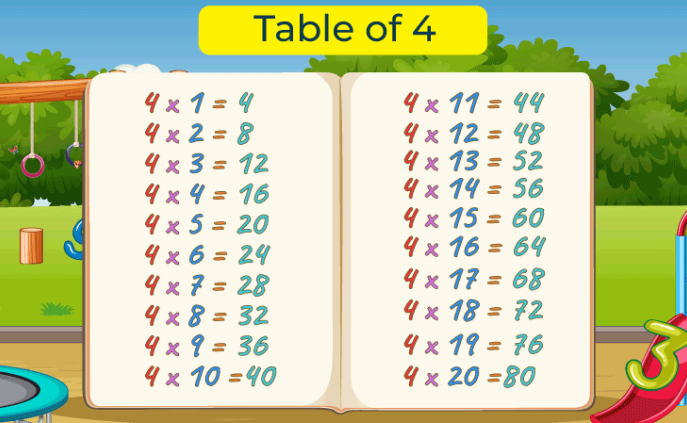
Multiple of 4 = 4 × n, where n is any whole number.
For examples:
- 4 × 0 = 0
- 4 × 1 = 4
- 4 × 2 = 8
- 4 × 3 = 12
- 4 × 4 = 16
These are the first five multiples of 4: 0, 4, 8, 12, and 16.
The value of “n” can be infinite. This means that 4, like any other number, has an infinite number of multiples.
List of Multiples of 4
Understanding the first 30 multiples of 4 can help you pass elementary school exams; let’s learn together.
The below table contains the first 30 multiples of 4 along with the multiplication notation in each case:
| Multiplication of 4 with Natural Numbers | Multiples of 4 |
| 4 × 1 | 4 |
| 4 × 2 | 8 |
| 4 × 3 | 12 |
| 4 × 4 | 16 |
| 4 × 5 | 20 |
| 4 × 6 | 24 |
| 4 × 7 | 28 |
| 4 × 8 | 32 |
| 4 × 9 | 36 |
| 4 × 10 | 40 |
| 4 × 11 | 44 |
| 4 × 12 | 48 |
| 4 × 13 | 52 |
| 4 × 14 | 56 |
| 4 × 15 | 60 |
| 4 × 16 | 64 |
| 4 × 17 | 68 |
| 4 × 18 | 72 |
| 4 × 19 | 76 |
| 4 × 20 | 80 |
| 4 × 21 | 84 |
| 4 × 22 | 88 |
| 4 × 23 | 92 |
| 4 × 24 | 96 |
| 4 × 25 | 100 |
| 4 × 26 | 104 |
| 4 × 27 | 108 |
| 4 × 28 | 112 |
| 4 × 29 | 116 |
| 4 × 30 | 120 |
From the table above, we can see that a multiple of 4 is the result in the multiplication table of 4 because both are the same.
What’s the Multiples of 4 Up to 150?
I believe you must be curious about which multiples of 4 exist within 150. In fact, this is also a very important knowledge point.
Multiples of 4 are numbers you get when you keep adding 4:
4, 8, 12, 16, 20,
24, 28, 32, 36, 40,
44, 48, 52, 56, 60,
64, 68, 72, 76, 80,
84, 88, 92, 96, 100,
104, 108, 112, 116, 120,
124, 128, 132, 136, 140,
144, 148

What are Common Multiples in Math?
Common multiples are the multiples that are common between a given set of numbers.After understanding multiples of 4, let us now learn about common multiples related to 4.
What’s the Least Common Multiple (LCM) of 4
What does the least common multiple (LCM) of 4 mean? The least common multiple (LCM) of a number is the smallest number that is a multiple of that number and at least one other number.
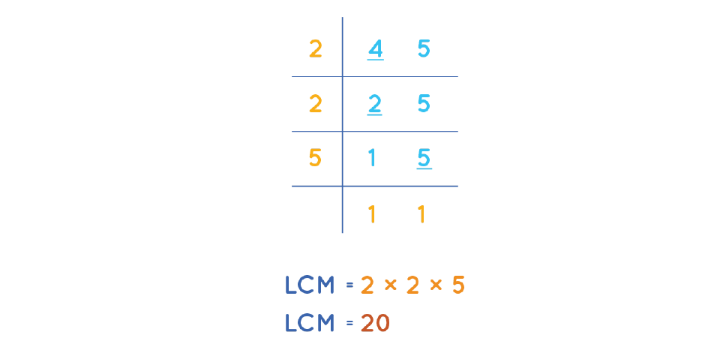
For example, the least common multiple of 4 and 5 is the smallest number of multiples of 4 and 5. In other words, the LCM of 4 and another number is the first number that appears in the multiplication table of both numbers.
For instance:
- The multiples of 4 are: 4, 8, 12, 16, 20, 24, 28, 32, 36, 40…
- The multiples of 5 are: 5, 10, 15, 20, 25, 30, 35, 40…
The smallest number that appears in both sequences is 20, so the least common multiple of 4 and 5 is 20.
1、What are the common multiples of 4 and 3?
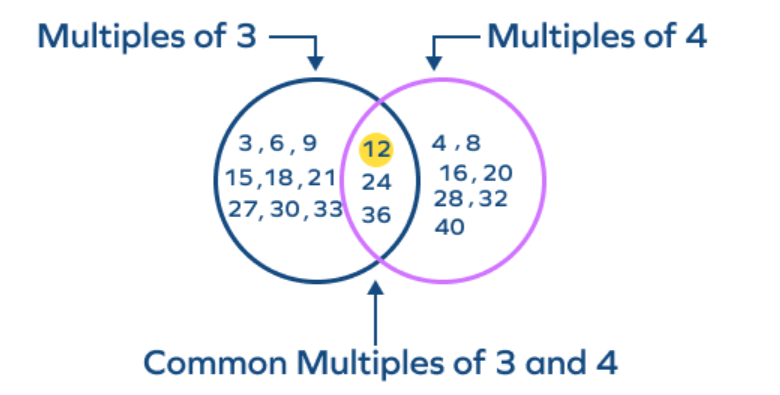
For example, to find the common multiple of 3 and 4, we list their multiples and then find their common multiple.
- The multiples of 3 are: 3, 6, 9, 12, 15, 18, 21, 24, 27, 30, 33, 36, …
- The multiples of 4 are: 4, 8, 12, 16, 20, 24, 28, 32, 36, 40, …
- The common multiples of 3 and 4 are: 12, 24, 36, …
2、What are the common multiples of 4 and 6?
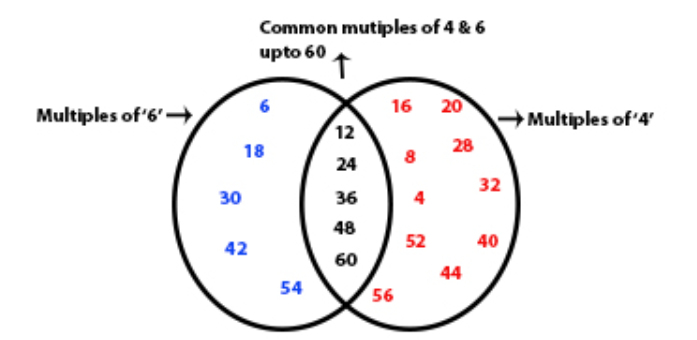
A multiple is the result of multiplying a number by a whole number. A common multiple of two or more numbers is a number that can be divided by each given number without remainder. A common multiple of two or more numbers is a number that can be divided by each given number without remainder, and this applies to all the numbers in the sequence.
These multiples common to two or more numbers play a vital role in various mathematical operations and problem-solving.
Steps to find common multiples of 4 and 6:
- Step 1: List the multiples of 4 and 6 separately
The multiples of 4 are 4, 8, 12, 16, 20, 24, 28, 32, 36, 40,… and so on.The multiples of 6 are 6, 12, 18, 24, 30, 36, 42, 48, 54, 60,… and so on.
- Step 2: Identify all the multiples that are common in both lists.
- Step 3: Write down all the common multiples in a separate row.
So the common multiples of 4 and 6 are 12, 24, 36, 48, 60, 72, 84, 96, 108, 120,… and so on. Additional common multiples can be identified by continuing this pattern.
3、What’s the Common Multiples of 4 and 7?
- Multiples of 4: 4, 8, 12, 16, 20, 24, 28, 32, 36, 40, 44, 48, 52, 56, 60, …
- Multiples of 7: 7, 14, 21, 28, 35, 42, 49, 56, 63, …
Common multiples of 4 and 7:
28, 56, 84, 112, …
LCM of 4 and 7: 28
4、What’s the Common Multiples of 4 and 8?
- Multiples of 4: 4, 8, 12, 16, 20, 24, 28, 32, 36, …
- Multiples of 8: 8, 16, 24, 32, 40, 48, 56, …
Common multiples of 4 and 8:
8, 16, 24, 32, 40, 48, …
LCM of 4 and 8: 8
(Since 8 is already a multiple of 4, every multiple of 8 is a common multiple.)
5、What’s the Common Multiples of 4 and 9?
- Multiples of 4: 4, 8, 12, 16, 20, 24, 28, 32, …
- Multiples of 9: 9, 18, 27, 36, 45, 54, 63, …
Common multiples of 4 and 9:
36, 72, 108, 144, …
LCM of 4 and 9: 36
5、What’s the Common Multiples of 4 and 10?
- Multiples of 4: 4, 8, 12, 16, 20, 24, 28, 32, …
- Multiples of 10: 10, 20, 30, 40, 50, 60, …
Common multiples of 4 and 10:
20, 40, 60, 80, 100, …
LCM of 4 and 10: 20
Quick Reference Table
| Numbers | Common Multiples (first few) | LCM |
|---|---|---|
| 4 & 3 | 12, 24, 36,48 | 12 |
| 4 & 5 | 20,40,60,80 | 20 |
| 4 & 6 | 12, 24, 36, 48, 60 | 12 |
| 4 & 7 | 28, 56, 84, 112 | 28 |
| 4 & 8 | 8, 16, 24, 32, 40 | 8 |
| 4 & 9 | 36, 72, 108, 144 | 36 |
| 4 & 10 | 20, 40, 60, 80, 100 | 20 |
Properties of common multiples
- A number can have an infinite number of multiples. Therefore, any two numbers or group of numbers can have an infinite number of common multiples.
- For any two numbers a and b, the product a x b is always a common multiple of a and b.
Example: 7 x 4 = 28 is a common multiple of 4 and 7.
If two numbers a and b are prime numbers, then their common multiple is a multiple of (a x b).
Solved Multiples of 4 Examples
Here are some examples of solved problems that provide answers to common questions about multiples of 4:
Example 1: What is the least common multiple of 4 and 10?
Answer: Step-by-Step Calculation of the LCM of 4 and 10
- List the multiples of 4:
4, 8, 12, 16, 20, 24, 28, …
- List multiples of 10
10, 20, 30, 40, …
- Find the smallest number that appears in both lists:
The least common multiple is 20.
Therefore, the least common multiple of 4 and 10 is 20.
Example 2: What is the 11th multiple of 4?
Answer: In this problem, we can use the “4n” formula to find the 11th multiple of 4.
Thus, when n = 11, 4n = 4 x n = 4 x 11 = 44
So, the 11th multiple of 4 is 44.
Example 3: Is 73 a multiple of 4?
Answer: 73 is not a multiple of 4. The multiples of 4 closest to 73 are 72 and 76.
How to Explain Multiples of 4 Simply to A Child?
Method 1 : Visualized on a Number Line
The number line below represents multiples of 4:
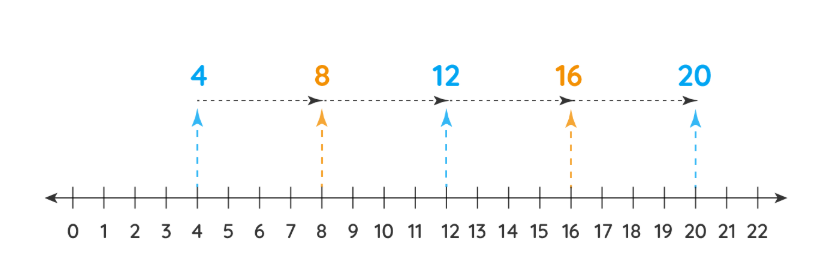
Here we can observe a pattern in multiples of 4: when we multiply 4 by n, there is a series of jumps that make 4 add n times.
Method 2 : Keep Adding 4
“Multiples of 4 are numbers you get when you keep adding 4.”
Start at 0 and count by 4s:
0, 4, 8, 12, 16, 20, 24, …
“If we make groups of 4, the total number is a multiple of 4.”
For example:
- 1 group of 4 → 4
- 2 groups of 4 → 8
- 3 groups of 4 → 12
- 4 groups of 4 → 16
Fun Tip for Kids:
- Use objects like blocks, candies, or pencils.
- Make groups of 4 and count the total. Every total is a multiple of 4!
- Or clap while counting 4, 8, 12, 16… to make it more fun.
Multiplication Tables
Multiplication Tables From 1-24
This collection of multiplication resources is designed to support mastery of Common Core State Standards for Operations and Algebraic Thinking. Specifically, it aligns with CCSS.MATH.CONTENT.3.OA.C.7, which requires students to fluently multiply and divide within 100, and 4.OA.B.4, focusing on factors and multiples. By exploring these tables, learners develop the algebraic foundation necessary for mental math fluency and higher-level problem solving.
| Multiplication Chart 1 to 20 | Multiplication Tables |
| 3 Times Table | 4 Times Table (this) |
| 5 Times Table | 6 Times Table |
| 7 Times Table | 8 Times Table |
| 9 Times Table | 10 Times Table |
| 11 Times Table | 12 Times Table |
| 13 Times Table | 14 Times Table |
| 15 Times Table | 16 Times Table |
| 17 Times Table | 18 Times Table |
| 19 Times Table | 20 Times Table |
| 21 Times Table | 22 Times Table |
| 23 Times Table | 24 Times Table |
FAQS
What are the multiples of 4?
Multiples of 4 are numbers you get when you multiply 4 by a whole number.
In simple words:
Keep adding 4 again and again.
Examples:
4 × 3 = 12
So, the multiples of 4 are:
4, 8, 12, 16, 20, 24, 28, 32, …
Multiples of 4 never end.
4 × 1 = 4 4 × 2 = 8
Are all multiples of 4 even?
Yes, all multiples of 4 are even because any number multiplied by an even number results in an even number. Since 4 is an even number, its multiples are also even.
What are the factors and multiples of 4?
The factors of 4 are 1, 2, and 4. The multiples of 4 include 4, 8, 12, 26, 20, 24, 28, 32, 36, 40, 44, etc.
Is 2 a multiple of 4?
No, 2 is not a multiple of 4.
What are the multiples of 4 up to 200?
Here is the complete list of multiples of 4 up to 200:
4, 8, 12, 16, 20,
24, 28, 32, 36, 40,
44, 48, 52, 56, 60,
64, 68, 72, 76, 80,
84, 88, 92, 96, 100,
104, 108, 112, 116, 120,
124, 128, 132, 136, 140,
144, 148, 152, 156, 160,
164, 168, 172, 176, 180,
184, 188, 192, 196, 200
There are 50 multiples of 4 up to 200, because
200 ÷ 4 = 50
What are the multiples of 4 up to 1000?
To find multiples of 4 up to 1000:
- Start at 4
- Keep adding 4
- Stop at 1000
The largest multiple of 4 up to 1000 is 1000, because:
1000 ÷ 4 = 250
That means there are 250 multiples of 4 up to 1000.
Examples from this list include:
4, 8, 12, 16, 20, … 100, 200, 500, 996, 1000
Is 52 a multiple of 4?
Yes , 52 is a multiple of 4.
Here’s why:
52 ÷ 4 = 13 (a whole number)
You can also check by counting:
48 → 52 (add 4)
Since 4 goes into 52 evenly, 52 is a multiple of 4.
Conclusion:
In this article, we explore what are the multiples of 4 and provide examples, as well as information about common multiples of 4 and more. Hopefully, this article will help you understand multiples better.
Having this information at your fingertips will not only improve your math skills but also help you to solve more advanced math problems. If you want to delve into more mathematics, consider taking the online math classes for kids. Their structured courses can provide you with the guidance and practice you need to help you continue to progress in math.
At WuKong Math, we’re committed to discovering the math whiz in every child, wherever they are, from grade 1 to grade 12. It goes beyond traditional teaching with Singapore’s proven CPA approach, guiding students from concrete examples to abstract modeling.
Discovering the maths whiz in every child,
that’s what we do.
Suitable for students worldwide, from grades 1 to 12.
Get started free!
Nathan, a graduate of the University of New South Wales, brings over 9 years of expertise in teaching Mathematics and Science across primary and secondary levels. Known for his rigorous yet steady instructional style, Nathan has earned high acclaim from students in grades 1-12. He is widely recognized for his unique ability to blend academic rigor with engaging, interactive lessons, making complex concepts accessible and fun for every student.


![How to Convert 28 Celsius to Fahrenheit? [Answer & Simple Guide]](https://wp-more.wukongedu.net/blog/wp-content/uploads/2024/12/convert-celsius-to-fahrenheit-520x293.png "How to Convert 28 Celsius to Fahrenheit? [Answer & Simple Guide]")

![How to Learn Abacus Maths at Home [2025 Guide]](https://wp-more.wukongedu.net/blog/wp-content/uploads/2024/01/image-142-520x293.jpeg "How to Learn Abacus Maths at Home [2025 Guide]")


![Top 5 Interactive Online Mandarin Lessons for Kids [2026 Guide]](https://wp-more.wukongedu.net/blog/wp-content/uploads/2023/12/image-244-520x293.png "Top 5 Interactive Online Mandarin Lessons for Kids [2026 Guide]")
![Learn Mandarin: Top 6 Tips + 4 Platforms [2025 Updated]](https://wp-more.wukongedu.net/blog/wp-content/uploads/2023/12/image-42-520x293.jpeg "Learn Mandarin: Top 6 Tips + 4 Platforms [2025 Updated]")


Comments0
Comments