

What are the Multiples of 6? [Solved Example + 6 Times Table]


Have you ever wondered what the multiples of 6 are and how they can be useful in everyday life? There are infinite multiples of 6, as you can keep multiplying 6 by any natural number endlessly.
In this article, WuKong Edu will explore the multiples of 6, including how many multiples exist, the smallest multiple, and the natural numbers that fall within this category.
Key Points of This Article at a Glance:
- multiples of 6 are: 6, 12, 18, 24, 30, 36, 42, 48, 54, 60, 66, 72, 78, 84, 90, 96, 102, 108, 114, 120…
- How many multiples of 6 are in 100? 16
- What are the Multiples of 6 Up to 150?
- Three methods to easily to learn
- Exampled and quick test
Discovering the maths whiz in every child,
that’s what we do.
Suitable for students worldwide, from grades 1 to 12.
Get started free!We will also provide a 6-times table, use repeated addition to find multiples and solve examples to reinforce your understanding. By the end, you’ll have a comprehensive grasp of the multiples of 6 and their significance.
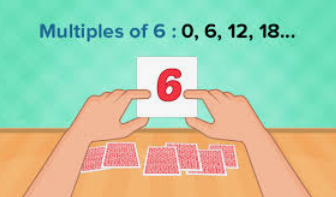
What are the Multiples of 6?
Multiples of 6 are numbers that can be divided by 6 without leaving a remainder. In simpler terms, a multiple of 6 is the result of multiplying 6 by any natural number. Some examples of multiples of 6 are: 6, 12, 18, 24, 30, 36, 42, 48, 54, 60, 66, 72, 78, 84, 90, 96, 102, 108, 114, 120…

How to Find the Multiples of 6?
To find the nth multiple of 6, we can use the formula: nth multiple of 6 = n × 6. For example, the 5th multiple of 6 is 5 × 6 = 30. We can also find multiples of 6 by repeated addition of 6. For instance, 6 + 6 + 6 + 6 + 6 = 30.
Multiples of 6 can be expressed in the form of 6n, where n is a natural number. For example, 6 × 1 = 6, 6 × 2 = 12, 6 × 3 = 18, and so on. The multiplication notation for multiples of 6 is 6 × n, where n is a natural number.
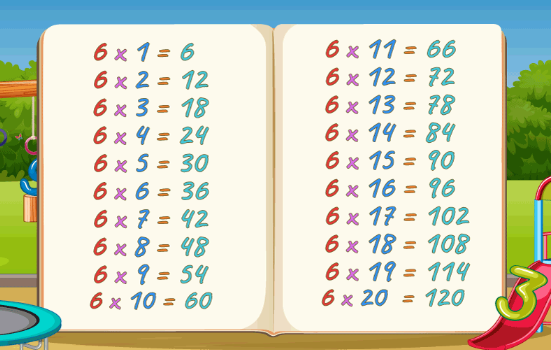
The above multiplication table shows the first 20 multiples of 6 in tabular form. We can see that the multiples of 6 have a difference of 6 between them. This is because the multiplication of 6 with any natural number always results in a multiple of 6.
How many multiples of 6 are in 100?
The number of multiples of 6 within 100 is 16.Wukong’s teacher carefully selected two simple and easy-to-understand methods to calculate.
Use the Formula
To find how many multiples of 6 are there between 1 to 100, we can use the formula:
number of multiples = (last multiple – first multiple) / 6 + 1.
For example, the first multiple of 6 is 6 and the last multiple of 6 less than 100 is 96. Therefore, the number of multiples of 6 between 1 to 100 is (96 – 6) / 6 + 1 = 16.
Step-by-Step Calculation
Another calculation method is to use division to find the resultThere is a step-by-step calculation process; let’s take a look together.
Step 1: Divide 100 by 6
Divide 100 by 6 to find the maximum whole-number multiple:
100 ÷ 6 = 16.66…
Step 2: Take the Integer Part
Only whole numbers count when finding multiples, so we take the integer part:
[16]
Step 3: Verify the Result
- (6 × 16 = 96) → ✔️ the largest multiple of 6 less than or equal to 100
- (6 × 17 = 102) → ❌ exceeds 100
This confirms that 96 is the largest multiple of 6 ≤ 100.
List of Multiples of 6 up to 100
6, 12, 18, 24, 30,
36, 42, 48, 54, 60,
66, 72, 78, 84, 90,
96
What are the Multiples of 6 Up to 150?
For children who are in school, it is essential to understand Multiples of 6 Up to 150. Let us take a look together.
Multiples of 6 (≤ 150)
This table lists the first 25 multiples of 6, from 6 × 1 to 6 × 25.
| 6 | 60 | 108 |
| 12 | 66 | 114 |
| 18 | 72 | 120 |
| 24 | 78 | 126 |
| 30 | 84 | 132 |
| 36 | 90 | 138 |
| 42 | 96 | 144 |
| 48 | 102 | 150 |
| 54 |
Summary:
- There are 25 multiples of 6 from 6 to 150.
- The largest multiple of 6 not exceeding 150 is 150.
- They form a simple arithmetic sequence, increasing by 6 each time.
How to Explain Multiples of 6 Simply to a Child?
To enable children to learn about multiples of 6, it is necessary to employ methods that are easy for them to understand. Today, Wukong presents three approaches that have been proven effective by many children: one is the multiplication table, which is highly suitable for children who have already learned multiplication; the other method is applicable to children with a foundation in addition.Another method that is suitable regardless of whether one has a foundation or not is a visual approach.
6 Times Table
To effectively understand the multiples of 6, it’s helpful to look at the 6 times table, this table can help you quickly recall the first ten multiples of 6.
| Multiplication of 6 with numbers | Multiples of 6 | Multiplication of 6 with numbers | Multiples of 6 |
| 6 × 1 | 6 | 6 × 11 | 66 |
| 6 × 2 | 12 | 6 × 12 | 72 |
| 6 × 3 | 18 | 6 × 13 | 78 |
| 6 × 4 | 24 | 6 × 14 | 84 |
| 6 × 5 | 30 | 6 × 15 | 90 |
| 6 × 6 | 36 | 6 × 16 | 96 |
| 6 × 7 | 42 | 6 × 17 | 102 |
| 6 × 8 | 48 | 6 × 18 | 108 |
| 6 × 9 | 54 | 6 × 19 | 114 |
| 6 × 10 | 60 | 6 × 20 | 120 |
Free Multiplication table of 6 Worksheet: Download Printable Free
Multiples of 6 by Repeated Addition
Another way to find the multiples of 6 is through repeated addition. For instance, you can start from 0 and keep adding 6:
- Start at 0
- 0 + 6 = 6
- 6 + 6 = 12
- 12 + 6 = 18
- 18 + 6 = 24
- 24 + 6 = 30
- 30 + 6 = 36
Continuing this process, the fifth multiple of 6 is 30, the sixth multiple of 6 is 36.

By continuing this process, you will generate an endless list of multiples of 6, demonstrating that they are spaced evenly apart.
Visualized on a Number Line
Another approach is to present it through digital online displays. This visual method is simpler and allows children to remember more clearly.

Solved Examples on Multiples of 6
Examples are the key to helping children understand and master knowledge. Well-chosen examples can encompass a wide range of knowledge points.Here are five solved examples on multiples of 6, complete with answers and explanations:
Example 1: Find the 5th Multiple of 6
Question: What is the 5th multiple of 6?
Solution:
To find the 5th multiple of 6, use the formula:
5th Multiple=6×5text{5th Multiple} = 6 times 5 5th Multiple=6×5
Calculating this gives:
6×5=306 times 5 = 30 6×5=30
Answer: The 5th multiple of 6 is 30.
Example 2: Determine if 48 is a Multiple of 6
Question: Is 48 a multiple of 6?
Solution:
To check if 48 is a multiple of 6, divide 48 by 6:
48÷6=8
Since 8 is a whole number, it confirms that 48 is indeed a multiple of 6.
Answer: Yes, 48 is a multiple of 6.
Example 3: List the First Four Multiples of 6
Question: What are the first four multiples of 6?
Solution:The first four multiples of 6 can be found by multiplying 6 by the first four natural numbers:
- 6×1=66 times 1 = 66×1=6
- 6×2=126 times 2 = 126×2=12
- 6×3=186 times 3 = 186×3=18
- 6×4=246 times 4 = 246×4=24
Answer: The first four multiples of 6 are 6, 12, 18, and the fourth multiple, 24.
Example 4: Find the 10th Multiple of 6
Question: What is the 10th multiple of 6?
Solution:
Using the formula for multiples, we find:
10th Multiple=6×10text{10th Multiple} = 6 times 10 10th Multiple=6×10
Calculating this gives:
6×10=606 times 10 = 60 6×10=60
Answer: The 10th multiple of 6 is 60.
Example 5: Identify the Smallest Multiple of 6 Greater Than 50
Question: What is the smallest multiple of 6 that is greater than 50?
Solution:
To find this, we can list the multiples of 6 until we find one greater than 50:
- 6 (1)
- 12 (2)
- 18 (3)
- 24 (4)
- 30 (5)
- 36 (6)
- 42 (7)
- 48 (8)
- 54 (9)
The first multiple greater than 50 is 54.
Answer: The smallest multiple of 6 greater than 50 is 54.
Quick Test : Interactive Questions on Multiples of 6
Alright, boys and girls, you have already mastered the multiples of 6. Now, follow the teacher to take a simple test.
Question 1: What is the 12th multiple of 6?
A) 60
B) 72
C) 48
D) 54
Correct Answer: B) 72
Question 2: Which of the following numbers is a multiple of 6?
A) 28
B) 36
C) 45
D) 50
Correct Answer: B) 36
Question 3: How many multiples of 6 are there between 1 and 50?
A) 8
B) 9
C) 7
D) 10
Correct Answer: B) 9 (The multiples are 6, 12, 18, 24, 30, 36, 42, 48)
Question 4: Which of the following is NOT a multiple of 6?
A) 18
B) 24
C) 34
D) 72
Correct Answer: C) 34
Question 5: What is the sum of the first three multiples of 6?
A) 54
B) 36
C) 48
D) 30
Correct Answer: A) 54 (The first three multiples are 6, 12, and 18; 6 + 12 + 18 = 36)
Multiplication Tables
Multiplication Tables From 1-24
This collection of multiplication resources is designed to support mastery of Common Core State Standards for Operations and Algebraic Thinking. Specifically, it aligns with CCSS.MATH.CONTENT.3.OA.C.7, which requires students to fluently multiply and divide within 100, and 4.OA.B.4, focusing on factors and multiples. By exploring these tables, learners develop the algebraic foundation necessary for mental math fluency and higher-level problem solving.
| Multiplication Chart 1 to 20 | Multiplication Tables |
| 3 Times Table | 4 Times Table |
| 5 Times Table | 6 Times Table (this) |
| 7 Times Table | 8 Times Table |
| 9 Times Table | 10 Times Table |
| 11 Times Table | 12 Times Table |
| 13 Times Table | 14 Times Table |
| 15 Times Table | 16 Times Table |
| 17 Times Table | 18 Times Table |
| 19 Times Table | 20 Times Table |
| 21 Times Table | 22 Times Table |
| 23 Times Table | 24 Times Table |
A quick way to recall the multiples of 6 is to memorize the 6 times table. With practice, you will be able to recall them effortlessly.
Factors of 6 are the numbers you can multiply together to get 6 (1, 2, 3, 6), while multiples of 6 are the result of multiplying 6 by natural numbers (6, 12, 18, …).
The multiples of 6 extend infinitely: 6, 12, 18, 24, 30, 36, and so forth. This demonstrates that there are infinite multiples of 6, as you can keep multiplying 6 by any natural number endlessly.
Common multiples of two numbers (like 6 and 8) are numbers that are multiples of both. For example, 24 is a common multiple of 6 and 8.
Multiples of 6 are numbers you get when you keep adding 6:
6, 12, 18, 24, 30,
36, 42, 48, 54, 60,
66, 72, 78, 84, 90,
96
Tip for kids: Count by 6s: 6, 12, 18, 24… It helps spot patterns easily.
Keep counting by 6 starting from the smallest multiple above 100:
102, 108, 114, 120, 126, 132, 138, 144, 150, 156, 162, 168, 174, 180, 186, 192, 198
Start at the first multiple of 6 after 100 and add 6 each time.
There are infinitely many multiples of 6 because you can keep adding 6 forever.
Examples: 6, 12, 18, 24, 30, 36, 42, …
To find this:
1000÷6=166 remainder 4
That means the largest multiple of 6 ≤ 1000 is 996
There are 166 multiples of 6 from 1 to 1000
Tip for kids: Divide the highest number by 6 to see how many multiples there are.
Conclusion
Understanding the multiples of 6 is not just about memorizing numbers; it’s about recognizing their relevance in various real-world scenarios. Whether you’re helping your child with math homework or trying to manage time efficiently, knowing the multiples of 6 can be incredibly beneficial. If you’re interested in deepening your mathematical skills, consider enrolling in WuKong Math courses, where you can explore these concepts further and enhance your understanding of mathematics.
Discovering the maths whiz in every child,
that’s what we do.
Suitable for students worldwide, from grades 1 to 12.
Get started free!
Graduated from Columbia University in the United States and has rich practical experience in mathematics competitions’ teaching, including Math Kangaroo, AMC… He teaches students the ways to flexible thinking and quick thinking in sloving math questions, and he is good at inspiring and guiding students to think about mathematical problems and find solutions.


![How Many Minutes Are in a Year? [With Online Calculator]](https://wp-more.wukongedu.net/blog/wp-content/uploads/2024/09/image-19-520x293.png "How Many Minutes Are in a Year? [With Online Calculator]")
![70+ Math Problems for 5th Graders [Answers & Worksheets Printable]](https://wp-more.wukongedu.net/blog/wp-content/uploads/2024/06/image-194-520x293.png "70+ Math Problems for 5th Graders [Answers & Worksheets Printable]")


-1-520x293.jpg "Mental Strategies to Overcome Mathematics Difficulties: Helping Young Learners Establish a Positive Learning Attitude")
Comments0
Comments