

Factors of 36: A Complete Guide with All Knowledge Points


Wukong Math: Key Points of Factors of 36 at a Glance:
- Positive factors of 36 are 1, 2, 3, 4, 6, 9, 12, 18, and 36
- Negative factors of 36 are -1, -2, -3, -4, -6, -9, -12, -18 and -36
- Prime Factors of 36 are 2 and 3
- Prime Factorization of 36 is 2 × 2 × 3 × 3
- Factors of 36 Tree
- Factors Pairs of 36:(1, 36),(2, 18),(3, 12),(4, 9),(6, 6),(-1, -36),(-2, -18),(-3, -12),(-4, -9),(-6, -6)

I. What Are the Factors of 36?
Positive Factors of 36
The positive factors of 36 are found by testing divisibility or using prime factorization:
1, 2, 3, 4, 6, 9, 12, 18, 36.
Negative Factors of 36
Negative factors of 36 are simply the negatives of its positive factors:
-1, -2, -3, -4, -6, -9, -12, -18, -36.
Discovering the maths whiz in every child,
that’s what we do.
Suitable for students worldwide, from grades 1 to 12.
Get started free!II. 2 Easy Ways to Find the Factors of 36
Method 1: The Factors Pair Method (Rainbow Method)
This is the most visual and beginner-friendly method. We start with 1 and find its “partner,” then move to 2, and so on. Connecting them makes a rainbow!

- Start with 1: 1 x 36 = 36. So, 1 and 36 are a factor pair. Write them at opposite ends of your list.
- Try 2: 36 ÷ 2 = 18. No remainder! So, 2 and 18 are a factor pair. Add them inside your list: 1, 2, …, 18, 36.
- Try 3: 36 ÷ 3 = 12. No remainder! Add 3 and 12: 1, 2, 3, …, 12, 18, 36.
- Try 4: 36 ÷ 4 = 9. No remainder! Add 4 and 9: 1, 2, 3, 4, …, 9, 12, 18, 36.
- Try 5: 36 ÷ 5 = 7 R1. Has a remainder. So, 5 is not a factor.
- Try 6: 36 ÷ 6 = 6. No remainder! This is a special pair where the partners are the same number.
- You can stop! Once you reach a repeated factor (like 6), you know you’ve found all factors.
Your complete list from smallest to largest is: 1, 2, 3, 4, 6, 9, 12, 18, 36. Great job!
Method 2: Finding Factors via Divisibility Rule
Use these shortcuts to identify factors:
- Divisible by 2: Even numbers (e.g., 2, 4, 6).
- Divisible by 3: Sum of digits is divisible by 3 (3 + 6 = 9 → divisible by 3).
- Divisible by 4: Last two digits form a number divisible by 4 (36 → 36 ÷ 4 = 9).
- Divisible by 6: Divisible by both 2 and 3.
- Divisible by 9: Sum of digits is divisible by 9.
Example:
Testing 12 as a factor:
36 ÷ 12 = 3 → No remainder.
Thus, 12 is a factor.
III. Prime Factorization of 36
This method is like finding a number’s DNA! We break 36 down into its smallest prime factors (numbers only divisible by 1 and themselves, like 2, 3, 5, 7).
- Find two factors of 36. Let’s start with 6 and 6.
- Break down non-prime factors. 6 can be broken into 2 and 3.
- Stop at prime numbers. Now we only have prime numbers (2, 2, 3, 3).
The prime factorization is 2 x 2 x 3 x 3, or 2² x 3².
How does this give us ALL factors? Combine the prime factors in different ways:
- 2 = 2
- 3 = 3
- 2 x 2 = 4
- 2 x 3 = 6
- 3 x 3 = 9
- 2 x 2 x 3 = 12
- 2 x 3 x 3 = 18
- 2 x 2 x 3 x 3 = 36
- Don’t forget the factor 1! (It’s the factor for every number)
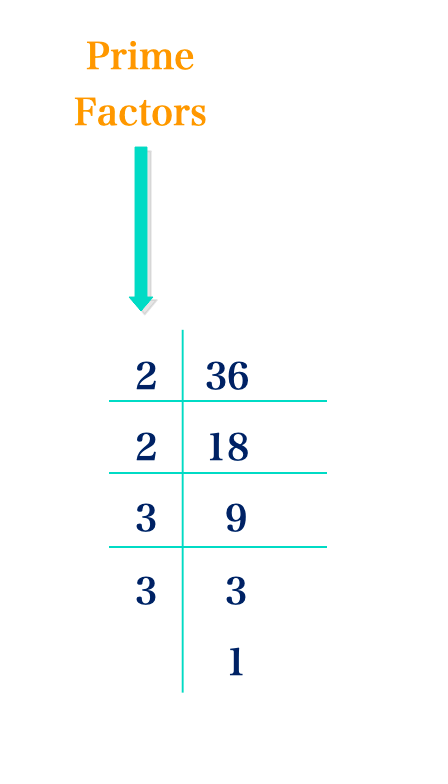
You get the same list: 1, 2, 3, 4, 6, 9, 12, 18, 36.
IV.Factors of 36 Tree
A factor tree graphically represents prime factorization:
- Start with 36, split into 2 and 18.
- Split 18 into 2 and 9.
- Split 9 into 3 and 3.

This factor tree shows that 36 prime factors are 2 and 3, each squared.
Why Use Prime Factorization?
- Identifies prime factors efficiently.
- Helps calculate the total number of factors .
V. Factor Pairs of 36
Factor pairs are two numbers that multiply to the original number.
Positive Factor Pairs: all the positive factors of 36
| Pair | Product |
|---|---|
| (1, 36) | 36 |
| (2, 18) | 36 |
| (3, 12) | 36 |
| (4, 9) | 36 |
| (6, 6) | 36 |
Negative Pair Factors
| Pair | Product |
|---|---|
| (-1, -36) | 36 |
| (-2, -18) | 36 |
| (-3, -12) | 36 |
| (-4, -9) | 36 |
| (-6, -6) | 36 |
Note: Negative pair factors require two negative numbers to yield a positive product. For instance, (-2) × (-18) = 36.
VI. More About Factors of 36
1、Properties of 36
36 is a perfect square (6²=36)
2、Sum of Divisors of 36
The sum of all positive divisors of 36 is
3、Special Divisors of 36
The smallest positive divisor is 1, the largest positive divisor is 36, and the only square single divisor is 6
4、Factors of 36′ Parity
Among the positive divisors of 36, the odd divisors are 1, 3, 9 (a total of 3), and the even divisors are 2, 4, 6, 12, 18, 36 (a total of 6)
5、Common Factors of 36
Example 1: Common Factors of 24 and 36
- Factors of 24: 1, 2, 3, 4, 6, 8, 12, 24
- Factors of 36: 1, 2, 3, 4, 6, 9, 12, 18, 36
- Common factors: 1, 2, 3, 4, 6, 12
- Greatest Common Factor (GCF): 12
Example 2: Common Factors of 18 and 36
- Factors of 18: 1, 2, 3, 6, 9, 18
- Factors of 36: 1, 2, 3, 4, 6, 9, 12, 18, 36
- Common factors: 1, 2, 3, 6, 9, 18
- GCF: 18
VII. Mastering Factors and Multiples
Understanding how to identify factors is a core competency within the Common Core State Standards for Mathematics. This skill is primarily introduced in Grade 4 (4.OA.B.4), where students learn to find all factor pairs for whole numbers in the range 1–100. It is further refined in Grade 6 (6.NS.B.4) as students apply these concepts to find the Greatest Common Factor (GCF) and solve real-world problems.
Factor Reference Table
| Number | Quick Link to Factor Guide |
| 9 | Factors of 9 |
| 10 | Factors of 10 |
| 21 | Factors of 21 |
| 24 | Factors of 24 |
| 36 | Factors of 36 (this) |
| 48 | Factors of 48 |
| 60 | Factors of 60 |
Conclusion
The factors of 36—both positive and negative—illustrate foundational mathematical principles. Through prime factorization, we uncover its prime factors (2 and 3), while factor pairs and divisibility rules provide practical tools for problem-solving.
Whether calculating the GCF, simplifying fractions, or exploring algebraic equations, understanding factors empowers you to tackle diverse challenges. Remember, the whole numbers like 36 are more than digits; they are gateways to logical thinking and analytical mastery.
FAQ About Factors of 36
A: The greatest common factor of 24 and 36 is 12.
A: 2 and 3.
A: The positive factor pairs of 36 are (1, 36), (2, 18), (3, 12), (4, 9), and (6, 6).
A: 36 itself.
Discovering the maths whiz in every child,
that’s what we do.
Suitable for students worldwide, from grades 1 to 12.
Get started free!
I am an educator from Yale University with ten years of experience in this field. I believe that with my professional knowledge and teaching skills, I will be able to contribute to the development of Wukong Education. I will share the psychology of children’s education and learning strategies in this community, hoping to provide quality learning resources for more children.


![Stanford Math Tournament: Registration, Date, Past Papers & Answers [2025 Guide]](https://wp-more.wukongedu.net/blog/wp-content/uploads/2024/04/image-1-520x293.jpeg "Stanford Math Tournament: Registration, Date, Past Papers & Answers [2025 Guide]")


![How to Motivate Students to Learn Math Effectively [2025 Guide]](https://wp-more.wukongedu.net/blog/wp-content/uploads/2024/01/image-141-520x293.jpeg "How to Motivate Students to Learn Math Effectively [2025 Guide]")
![Math Counts 2026 Comprehensive Guide[with free PDF]](https://wp-more.wukongedu.net/blog/wp-content/uploads/2024/02/下载-3-520x293.webp "Math Counts 2026 Comprehensive Guide[with free PDF]")

Comments0
Comments