

How to Say Please in Chinese: 请 (Qǐng) + Polite Phrases & Cultural Tips


What Is “Please” in Chinese?
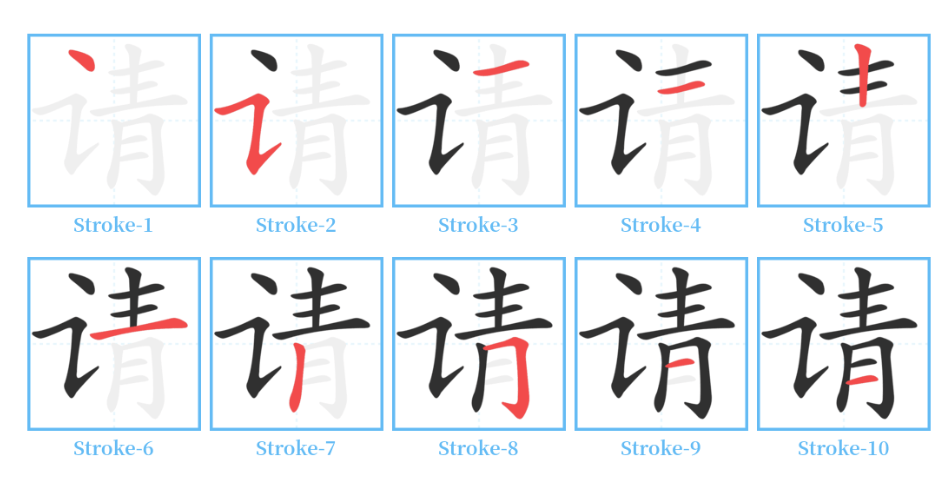
The English word “please” is most commonly expressed as 请 (qǐng) in Mandarin Chinese, which means “please” when used to make a polite request. 请 (qǐng) can appear before a verb to make a request, invitation, or instruction more polite, but Chinese does not use 请 in every situation where English uses “please.” Cambridge Dictionary defines 请 (qǐng) as “please” for polite requests and also lists “ask” and “invite” as other meanings.
For example, 请坐 (qǐng zuò, “please sit”) and 请进 (qǐng jìn, “please come in”) use 请 directly before the action. In everyday Chinese, however, speakers can also use expressions such as 请问 (qǐng wèn, “may I ask / excuse me”) or 麻烦你 (má fan nǐ, “could you please / may I trouble you”), depending on the request and social context.

How Do You Say Please in Chinese?
请 (qǐng) — “Please”
请 (qǐng) is the standard Mandarin word for “please” when making a polite request or giving a courteous instruction. The word is pronounced qǐng, with the third tone, and it commonly appears before the verb or action being requested. Cambridge Dictionary specifically identifies 请 as an A1 expression used to make a request more polite.
A simple structure is:
请 (qǐng) + Verb
For example:
请坐。
Qǐng zuò.
Please sit.
Here:
- 请 (qǐng) — please
- 坐 (zuò) — sit
Another common example is:
请进。
Qǐng jìn.
Please come in.
Here:
- 请 (qǐng) — please
- 进 (jìn) — enter / come in
The key grammar point is that 请 (qǐng) normally comes before the action rather than being placed at the end of a Chinese sentence like English “please” often can be.
Learn authentic Chinese from those who live and breathe the culture.
Specially tailored for kids aged 3-18 around the world!
Get started free!How Do You Pronounce 请 (qǐng) Correctly?
请 (qǐng) is pronounced qǐng, with a third-tone contour in standard Mandarin.
The initial q in Pinyin is an aspirated sound made with the tongue positioned toward the front of the mouth. The final -ing should be pronounced as part of one syllable: qǐng, not as separate “qing” sounds.
Tone matters because Mandarin uses tones to distinguish words. For Chinese learners, confusing 请 (qǐng, “please”) with another pronunciation such as 轻 (qīng, “light”) can change the meaning.
What Does 请 (qǐng) Mean Beyond “Please”?
请 (qǐng) does not only mean “please”; it can also mean “to ask,” “to invite,” or “to treat someone,” depending on the sentence. MDBG lists these meanings for 请 and identifies the word as HSK 1 vocabulary.
- 请 (qǐng) — “Please”
Example:
请坐。
Qǐng zuò.
Please sit.
- 请 (qǐng) — “To Invite”
Example:
我请你吃饭。
Wǒ qǐng nǐ chī fàn.
I’ll treat you to a meal.
In this sentence, 请 (qǐng) means “to treat” or “to invite someone to a meal,” rather than the English interjection “please.”
- 请 (qǐng) — “To Ask”
Example:
我请你帮我一下。
Wǒ qǐng nǐ bāng wǒ yí xià.
I ask you to help me for a moment.
Therefore, Chinese learners should interpret 请 (qǐng) from its sentence structure instead of assuming that it always means the English word “please.”
How Do You Use 请问 (qǐng wèn) in Chinese?
请问 (qǐng wèn) means “may I ask?” or “excuse me, may I ask,” and is commonly used at the beginning of a polite question. The expression combines 请 (qǐng, “please”) with 问 (wèn, “ask”).
For example:
请问,洗手间在哪里?
Qǐng wèn, xǐ shǒu jiān zài nǎ lǐ?
Excuse me, where is the restroom?
Another example is:
请问,这个多少钱?
Qǐng wèn, zhè ge duō shao qián?
Excuse me, how much does this cost?
请问 (qǐng wèn) is particularly useful when asking a stranger for information, such as asking for directions, checking a price, or getting someone’s attention. Recent Chinese-learning discussions continue to identify 请问 as a natural way to open a polite question.
When Should You Use 麻烦 (má fan) Instead of 请 (qǐng)?
麻烦 (má fan) literally refers to “trouble,” “bother,” or “inconvenience,” but in a request it can function as a polite way of acknowledging that the other person is being asked to do something for you.
For example:
麻烦你帮我拿一下。
Má fan nǐ bāng wǒ ná yí xià.
Could you please help me carry this?
Here:
- 麻烦 (má fan) — trouble / bother
- 你 (nǐ) — you
- 帮 (bāng) — help
- 我 (wǒ) — me
- 拿 (ná) — take / carry
- 一下 (yí xià) — a moment / briefly
麻烦你 (má fan nǐ, “could you please / may I trouble you”) is especially useful when the request requires some effort from the other person. Recent Chinese-learning discussions describe this use as a polite way to acknowledge the inconvenience involved in helping with a request.
A more respectful version is:
麻烦您再说一遍。
Má fan nín zài shuō yí biàn.
Could you please say that again?
Here, 您 (nín) is the respectful form of “you.”
How Do 请 (qǐng) and 麻烦 (má fan) Differ?
| Usage / No. | Chinese (汉字 + Pinyin) | English Meaning / Sentence |
|---|---|---|
| 1 | 请 (qǐng) | Please — used for polite requests or instructions |
| 2 | 麻烦你 (má fan nǐ) | Could you please / may I trouble you — used for requests requiring help |
| 3 | 劳驾 (láo jià) | Excuse me / please — used to politely get someone’s attention or ask a favor |
| 4 | 拜托 (bài tuō) | Please / I beg you — used for a stronger, more personal request |
The table reflects the main expressions discussed in the original article, while the distinctions have been clarified for more natural usage.
What Are Other Ways to Say “Please” in Chinese?
What Does 劳驾 (láo jià) Mean in Chinese?
劳驾 (láo jià) is a polite expression meaning “excuse me” or “may I trouble you,” especially when getting someone’s attention or asking someone to move or help. Cambridge Dictionary describes 劳驾 as a polite way to attract someone’s attention, particularly when speaking to someone you do not know.
For example:
劳驾,请问最近的地铁站在哪里?
Láo jià, qǐng wèn zuì jìn de dì tiě zhàn zài nǎ lǐ?
Excuse me, could you tell me where the nearest subway station is?
劳驾 (láo jià) can sound more formal or marked than the most everyday request patterns, so Chinese learners do not need to use it in every conversation.
What Does 拜托 (bài tuō) Mean in Chinese?
拜托 (bài tuō) means “please,” “I beg you,” or “I’m asking you to,” and usually carries more emotional emphasis than neutral 请 (qǐng). WordReference lists 拜托 as “request” and “Please!” in English.
For example:
拜托,给我一次机会吧!
Bài tuō, gěi wǒ yí cì jī huì ba!
Please, give me one more chance!
Because 拜托 (bài tuō) can sound emotionally strong, it is better suited to personal pleas or emphatic requests than routine situations such as ordering food.
Do You Need to Say “Please” in Every Chinese Request?
No. Chinese does not require a direct equivalent of English “please” in every request.
The original article correctly identifies an important issue for English-speaking learners: translating every English request word-for-word can make Chinese sound unnatural. However, the stronger claim that Chinese speakers “rarely use please” should be qualified. 请 (qǐng) is a normal and widely understood politeness marker, but everyday requests can also be phrased directly, softened with question structures, or expressed through context and relationship. Cambridge explicitly defines 请 as a polite request marker, while recent learner discussions show that natural choices vary by situation.
For example, when ordering food, a speaker may simply say:
一份牛肉面。
Yí fèn niú ròu miàn.
One bowl of beef noodles.
The sentence is not automatically rude because it lacks 请 (qǐng). The situation, tone, relationship, and surrounding language all contribute to how polite a request sounds.
By contrast, 请给我一份牛肉面 (qǐng gěi wǒ yí fèn niú ròu miàn, “please give me one bowl of beef noodles”) is grammatically understandable and can be appropriate, but it is not necessary simply because English would normally include “please.”
Why Does English “Please” Not Always Equal 请 (qǐng)?
English “please” has several grammatical meanings, and only some of them correspond directly to 请 (qǐng).
When “please” makes a request more polite, 请 (qǐng) is often the appropriate Chinese equivalent.
For example:
Please sit down.
请坐。
Qǐng zuò.
But when English “please” means “make someone happy” or “satisfy someone,” the Chinese translation is different. Cambridge distinguishes these meanings of English “please,” including its use as a verb meaning “to make someone happy or satisfied.”
For example:
I only got married to please my parents.
A natural Chinese translation would use an expression meaning “make my parents happy,” rather than treating 请 (qǐng) as a direct one-word translation of the English verb “please.”
This distinction is important because “please” is an English polysemous word, while 请 (qǐng) has its own Chinese grammar and meanings.
What Are Common Mistakes When Saying “Please” in Chinese?
Mistake 1: Translating Every “Please” as 请 (qǐng)
请 (qǐng) is the main direct translation for polite requests, but it is not a universal translation for every meaning of English “please.”
Always check whether “please” is functioning as:
- a polite request;
- a strong plea;
- an invitation;
- or the verb “to make someone happy.”
Mistake 2: Using 请 (qǐng) in Every Casual Request
请 (qǐng) is correct, but Chinese speakers do not need to insert it into every request.
For a close friend, a direct request such as:
帮我一下。
Bāng wǒ yí xià.
Help me for a moment.
can sound natural because the relationship and tone already provide context.
Adding 请 (qǐng) is not grammatically wrong, but it can change the tone and may sound more deliberate or formal depending on the situation.
Mistake 3: Confusing 请问 (qǐng wèn) With 请 (qǐng)
请 (qǐng) is the general politeness marker, while 请问 (qǐng wèn) is a conventional opener for polite questions.
Compare:
请坐。
Qǐng zuò.
Please sit.
with:
请问,地铁站在哪里?
Qǐng wèn, dì tiě zhàn zài nǎ lǐ?
Excuse me, where is the subway station?
The two expressions are related, but they serve different grammatical functions.
Mistake 4: Using 拜托 (bài tuō) for Tiny Requests
拜托 (bài tuō) can carry stronger emotional emphasis than 请 (qǐng).
Using 拜托 for a routine request can therefore sound unnecessarily dramatic.
For everyday requests, 请 (qǐng) or 麻烦 (má fan) is usually a safer starting point for learners.

FAQ About “Please” in Chinese
1. What is “please” in Chinese?
请 (qǐng).
请 (qǐng) is the standard Mandarin expression for “please” when making a polite request or instruction. Cambridge Dictionary lists 请 as the Chinese equivalent used to make requests more polite.
2. Does 请 (qǐng) always mean “please”?
No.
请 (qǐng) can also mean “to ask,” “to invite,” or “to treat someone,” depending on the sentence. MDBG lists these meanings in its Chinese-English dictionary.
3. Is 请问 (qǐng wèn) the same as 请 (qǐng)?
Not exactly.
请问 (qǐng wèn) literally combines 请 (qǐng, “please”) and 问 (wèn, “ask”), and it functions as a polite way to begin a question, often translated as “may I ask?” or “excuse me.” It is especially useful when asking strangers for information.
4. Is 麻烦 (má fan) more polite than 请 (qǐng)?
Not always.
麻烦 (má fan) acknowledges that the requested action may inconvenience or require effort from the other person, so it can sound considerate in requests for help. 请 (qǐng) is a more general politeness marker and is appropriate in many different contexts. Recent Chinese-learning discussions continue to distinguish these expressions based on the type of request rather than treating one as universally “more polite.
More Basic Chinese Phrases You Must Learn
| Chinese Phrase | Description |
|---|---|
| goodnight in chinese | Different ways to say good night to friends, family, or children. |
| what’s up in Chinese | Casual greeting used among friends. |
| Thank You in Chinese | Express gratitude in formal and informal situations. |
| cheers in chinese | Toasting with friends or at a formal dinner. |
| good morning in chinese | Morning greeting for family, colleagues, or classmates. |
| hi in chinese | Saying hello in formal meetings or to friends. |
| i don’t know in chinese | Politely indicating you don’t have an answer. |
| im sorry in chinese | Apologizing for a minor mistake or a serious matter. |
| nice to meet you in chinese | First-time introduction in a casual or business setting. |
| okay in mandarin | Giving agreement, approval, or saying “It’s fine.” |
| please in chinese (this article) | Making a polite request. |
| what is your name in chinese | Asking someone’s name when you first meet them. |
Conclusion: Use Chinese Requests Naturally
The most direct way to say “please” in Mandarin is 请 (qǐng), but natural Chinese communication uses several request expressions depending on what you are asking and who you are speaking to.
Use 请 (qǐng) for straightforward polite requests, 请问 (qǐng wèn) when politely asking a question, 麻烦 (má fan) when acknowledging the effort involved in helping you, and 拜托 (bài tuō) when making a stronger or more personal plea.
The most important lesson for Chinese learners is not to translate the English word “please” mechanically. Instead, learn how Mandarin speakers structure requests in real situations. That distinction will help you sound more natural and understand why a grammatically correct sentence can still feel overly formal or unusual.
For children learning Mandarin, consistent exposure to real conversational patterns can make these distinctions easier to develop. WuKong Education offers live online Chinese classes for learners ages 3–18, with courses designed around Mandarin communication, pronunciation, vocabulary, and real-world language use.
Learn authentic Chinese from those who live and breathe the culture.
Specially tailored for kids aged 3-18 around the world!
Get started free!
Bella holds a Master’s degree from Yangzhou University and brings 10 years of extensive experience in K-12 Chinese language teaching and research. A published scholar, she has contributed over 10 papers to the field of language and literature. Currently, Bella leads the research and development of WuKong Chinese core courses, where she prioritizes academic rigor alongside student engagement and cognitive development. She is dedicated to building a robust foundation for young learners covering phonetics (Pinyin), characters, idioms, and classical culture while ensuring that advanced courses empower students with comprehensive linguistic mastery and cultural insight.


![List of 214 Basic Chinese Radicals and Meanings [Free PDF]](https://wp-more.wukongedu.net/blog/wp-content/uploads/2024/05/生成汉字部首列表图片-最大宽度-1024-最大高度-768-520x293.webp "List of 214 Basic Chinese Radicals and Meanings [Free PDF]")


![Year of Monkey Chinese Zodiac [2026 Full Guide]](https://wp-more.wukongedu.net/blog/wp-content/uploads/2024/01/询问中文早上好的说法-22-520x293.png "Year of Monkey Chinese Zodiac [2026 Full Guide]")


Comments0
Comments