Flipping someone off in traffic feels universally understood. It is the ultimate boundary-crossing gesture, an instant shorthand for frustration that requires absolutely no translation across most of the Western world.
But in China, that same finger might just as easily connect you to 2,500 years of healing wisdom. To truly understand what does the middle finger mean in China, we must look beyond the surface level of modern pop culture.
1. Middle Finger From Western Perspective
To understand how China views this gesture, we must first establish the baseline of the Western world. Across the Americas and Europe, people universally recognize raising the middle finger as a sign of anger, defiance, and profound disrespect. This vulgarity insulates the speaker and humiliates the recipient.
This gesture is far from a modern invention. Its roots stretch back to ancient Greece, where it was known as the katapygon. It carried explicit phallic symbolism meant to insult or degrade another person’s masculinity. Historical anecdotes even note the philosopher Diogenes flipping off the orator Demosthenes to express his utter disdain. This anatomical insult carried over into the Roman Empire as the digitus impudicus (the shameless finger).
For centuries, this specific framework dominated Western non-verbal communication, eventually spreading worldwide through cinema, television, and globalization. Because this meaning is so deeply entrenched in the Western psyche, many travelers mistakenly assume that every culture on earth shares the exact same visceral reaction to this specific digit.
2. Mid Finger — A Gesture China Didn’t Originally Have
The core truth that surprises many Westerners is that traditional Chinese culture did not originally have the “middle finger” as an offensive gesture. Historically, raising this single digit held no vulgar meaning whatsoever in ancient China. Instead, its adoption as an insult is a relatively recent phenomenon, imported through Western media, Hollywood films, and the rapid globalization of the late 20th and early 21st centuries.
In traditional Chinese society, 儒家思想 Rújiā Sīxiǎng (Confucianism) deeply guided both verbal and non-verbal communication styles. Confucian values place an immense premium on 和谐 héxié (harmony), emotional restraint, and mutual respect. People traditionally viewed overt displays of raw anger as uncivilized, unrefined, and a profound loss of self-control.
Because of this cultural emphasis on subtlety, traditional Chinese insults were far more indirect. Rather than relying on a singular, aggressive hand gesture, people historically expressed displeasure through:
Highly sophisticated metaphorical poetry.
Indirect criticisms that allowed both parties to save face.
Intentional shifts in formal linguistic honorifics to signal coldness.
Furthermore, ancient China had its own set of strict physical taboos that carried far more offensive weight than an isolated middle finger. For instance, pointing the sole of your shoe at someone or slamming a clenched fist into an open palm were considered deeply insulting.
Understanding this historical foundation helps explain why older generations in China may still look at the gesture with confusion. That is because it completely lacks the deep-seated historical baggage found in the West.
3. The “Heavenly Finger” (天指) in Traditional Chinese Medicine
While the West viewed the middle finger through a lens of defiance, ancient Chinese scholars were mapping it onto an intricate system of anatomy and holistic health. In Traditional Chinese Medicine, the middle finger traditionally refers to as the 天指 tiān zhǐ (Heavenly Finger), which also usually shown in some Chinese manga. Rather than an instrument of conflict, it is regarded as a vital gateway for physical and psychological well-being. Even in Chinese movies, you might find its unique role.
To understand its role in healing, think of the body’s meridian system as an internal highway for energy, much like how Western medicine views the nervous or circulatory systems. The middle finger serves as the terminal pathway for the Pericardium Meridian. This is often linked structurally in holistic health with the 手少阴心经 (Heart Meridian). In TCM philosophy, the heart is not just a muscular pump; it houses the mind and governs our emotional equilibrium.
Because of this deep energetic connection, people use middle finger to:
Regulate intense emotions like anger and grief.
Calm acute bouts of anxiety and nervous tension.
Diagnose cardiovascular vitality through subtle pulse readings.
The practical application of this ancient wisdom persists today. For example, a 2018 clinical study published in the 中医杂志 (Journal of Traditional Chinese Medicine) found that targeted acupressure applied to the base and tip of the middle finger significantly helped alleviate physiological symptoms of anxiety and menopausal hot flashes in adult patients.
This presents a fascinating cross-cultural paradox. At the exact moment a Western driver might frantically flip their middle finger in a fit of road rage—inadvertently spiking their own blood pressure—a traditional Chinese medicine practitioner might be massaging that very same digit to lower a patient’s heart rate and restore internal peace.
This fascinating paradox isn’t just confined to medical history. It has also become a brilliant source of inspiration for modern pop culture. If you dive into contemporary Chinese comics and modern Chinese films, you will frequently see martial arts creators. They use this exact cultural clash as a running gag—where a character seemingly flips off an opponent, only to comically reveal they were actually targeting a vital acupressure point to seal their enemy’s energy.
4. Spiritual Meanings of Chinese Middle Finger
Beyond the realm of physical medicine, the middle finger occupies a sacred space within Eastern spiritual traditions.
Within these traditions, each finger represents a specific elemental force. When practicing sacred mudras:
The thumb represents the fire element or supreme consciousness.
The middle finger represents the earth element, anchoring stability, patience, and the spleen system.
When the tip of the thumb gently touches the tip of the middle finger, it completes an energetic loop that harmonizes internal fire with grounding earth.
A prominent example of this is the 说法印 shuōfǎ yìn (Vitarka Mudra), frequently depicted in ancient Buddhist statues throughout China. In this gesture, the Buddha raises his hand with the thumb and middle finger forming a perfect circle. This elegant ring symbolizes the continuous, uninterrupted flow of wisdom and the peaceful transmission of spiritual teachings to disciples. Far from being a sign of exclusion or anger, it is an invitation to universal truth and mental clarity.
At the same time, Chinese folk beliefs add another layer of mystique to our hands. A widespread piece of folklore cautions children against 指月亮 zhǐ yuèliang (pointing at the moon) with any finger, particularly the long middle finger. According to superstition, doing so directly disrespects the moon goddess 嫦娥 Cháng’é, who might retaliate by secretly clipping or scratching the offender’s ears while they sleep.
5. The Modern Shift: When China Learned the Western Meaning
The landscape of non-verbal communication in China began to shift rapidly with the dawn of the internet era. It also shows in the massive influx of Western pop culture. Through Hollywood blockbusters, competitive video games, European football broadcasts, and global social media platforms, younger generations of Chinese citizens quickly learned the Western connotation of the “Chinese middle finger.”
Today, this has created a fascinating generational divide across the country. A 2021 demographic survey published by the 中国青年报 Zhōngguó Qīngnián Bào (China Youth Daily) highlighted this cultural shift:
58% of respondents aged 18–30 immediately associated raising the middle finger with the Western profane insult.
72% of respondents over the age of 50 viewed the gesture as entirely meaningless, characterizing it as “foreign nonsense” or simply an anatomical curiosity.
This data demonstrates that context, location, and age matter immensely when navigating modern China. In cosmopolitan urban centers like Shanghai, Beijing, or Shenzhen, people will react to the gesture with the exact same hostility you would encounter on the streets of New York or Los Angeles.
However, the social context changes how peers use it. Among close younger friends, individuals frequently deploy the gesture as a tongue-in-cheek piece of ironic banter—a way to mimic Western media trends without carrying genuine malice.
Yet, in professional environments, traditional schools, or formal corporate meetings, using it remains an absolute taboo. It violates the core tenets of workplace harmony and shows a blatant disregard for professional decorum.
6. Chinese Sign Language
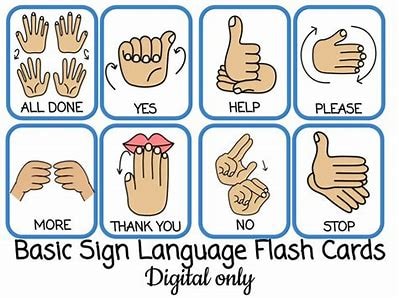
One of the clearest examples of how hand gestures diverge across cultures can be found in linguistics. In 中国手语 Zhōngguó Shǒuyǔ (Chinese Sign Language, or CSL), the physical mechanics of the hands follow a completely independent logic that catches many spoken-language speakers off guard.
Within CSL, raising the middle finger in isolation does not convey a single drop of profanity. Instead, because it is structurally the tallest and most central digit on the human hand, it is frequently utilized as a neutral linguistic marker. In various regional counting systems, sticking out the middle finger simply stands for the numerical value of 数字一 shùzì yī (the number “1”).
Extending the index finger alongside the middle finger signifies close 兄弟 xiōngdì (brotherhood) or deep friendship, entirely distinct from the Western peace sign.
Lightly tapping the middle finger against the center of the open palm translates directly to the word 父亲 fùqīn (father).
This stark linguistic difference was famously highlighted in a 2020 documentary broadcasted by 中国中央电视台 Zhōngguó Zhōngyāng Diànshìtái (CCTV). The program followed professional CSL interpreters as they adapted complex Western news broadcasts for deaf communities in China. The interpreters noted the constant challenge of translating Western political protests: they had to carefully distinguish between a Western protester raising a middle finger as a sign of anger, and the literal, neutral use of the digit within their own sign language system to avoid confusing viewers.
7. Beyond the Middle Finger: Related Gestures You Should Know
To successfully navigate social dynamics in China, it helps to expand your vocabulary of hand gestures beyond a single digit. Just like spoken vocabulary, physical movements can mean entirely different things depending on where you land.
Let’s look at a few vital daily gestures and how their meanings compare to the West:
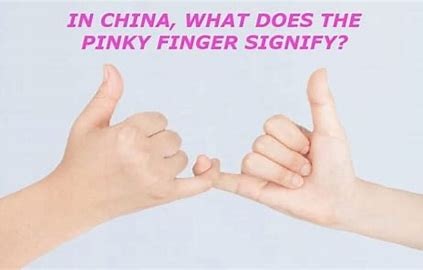
The Pinky Finger (小指 xiǎo zhǐ)
In Western cultures, making a pinky promise signifies a childhood pact. In traditional Chinese communities, however, holding up an isolated pinky finger to someone can mean they are “small,” “weak,” or in “last place.” Conversely, the act of interlocking pinkies—known as 拉钩 lā gōu—is taken very seriously as a symbol of deep, unbreakable mutual trust and binding agreement.
The Thumbs-Up (大拇指 dà mǔzhǐ)
While historically viewed in some remote parts of the world with mixed meanings, the thumbs-up has evolved beautifully in modern China. Today, it is the universal symbol for 棒 bàng (excellent, good job), widely used by teachers, bosses, and friends to show instant affirmation.
8. Cross-Culture Comparison Table
To help you visualize these differences at a glance, this comparative breakdown maps out how everyday physical gestures are interpreted in China versus the West.
Hand Gesture / Behavior
Meaning in Western Culture
Meaning in Traditional / Modern China
Middle Finger
Universal sign of anger, profanity, and personal defiance.
Historically linked to TCM healing (Heart Meridian) and Buddhist mudras; modern urban youth recognize the Western insult.
Thumbs-Up
Signifies approval, agreement, or hitchhiking.
Universally means 棒 bàng (excellent, top tier); a common sign of praise.
Direct Eye Contact
Signals confidence, honesty, and active listening.
Prolonged intensity can be perceived as challenging authority or confrontational; polite eye contact is softer and intermittent.
Slapping Thighs
Signals impatience, boredom, or a desire to wrap up a meeting.
Signifies a burst of hearty laughter, deep amusement, or a sudden “Aha!” realization.
The vast divide in how we process these physical movements is deeply rooted in our psychology. In a landmark cross-cultural communication study examining non-verbal interpretation frameworks:
89% of American participants associated the middle finger purely with anger or interpersonal hostility.
63% of Chinese participants living in traditional or semi-urban communities associated the digit primarily with health, anatomical balance, or standard physical movement rather than an insult.
9. Practical Etiquette—Navigating Chinese Social Situations
When traveling through Asia or interacting with Chinese colleagues, navigating these cultural waters can feel daunting. What happens if you make a mistake? What if an accidental slip of the hand shows an offensive “Chinese middle finger”?
The most reassuring rule to remember is that context always matters more than the gesture itself. Human beings are highly intuitive; people can easily tell the difference between an accidental hand movement and intentional hostility.
If you ever realize you’ve made a cultural faux pas, don’t panic. A simple, graceful recovery strategy works wonders across all cultures:
The Recovery Formula: Offer a sincere, lighthearted apology combined with a brief explanation of your cultural background. Saying something as simple as, “I am so sorry, I realized that gesture looks different here! In my hometown, we use it to mean X, but I didn’t mean any disrespect,” will instantly defuse any tension.
This approach succeeds because it respects the foundational Chinese concept of 面子 miànzi (face). In Chinese society, “face” represents a person’s social standing, dignity, and honor.
By proactively offering a polite explanation, you prevent the other person from losing face publicly, turning a potential misunderstanding into a beautiful moment of shared cultural learning.
10. FAQ: Frequently Asked Questions
Q1: Is the middle finger considered offensive in all parts of China?
A: In major metropolitan urban areas like Shanghai, Hong Kong, and Beijing, residents widely recognize the gesture as a Western insult due to globalization. However, in rural provinces or among older generations who didn’t grow up with Western media, the gesture carries no inherent meaning, and people there often view it simply as an ordinary finger.
Q2: What is the Chinese version of the middle finger?
A: China does not have a single, direct anatomical equivalent to the Western middle finger. Instead of using isolated hand gestures to convey intense anger, people traditionally express frustration through indirect means: falling completely silent, abruptly changing the topic, using sharp verbal metaphors, or routing disagreements through a mutual third party to preserve social harmony.
Q3: Does the pinky finger mean the same as the middle finger in China?
A: Not exactly. While the middle finger is an imported sign of aggressive defiance, turning your pinky finger (小指 xiǎo zhǐ) toward someone is a traditional way to signal that they are weak, unskilled, or finishing in u0022last place.u0022 It is dismissive rather than overtly profane.
Q4: Is thumbs up rude in China?
A: Not at all! The thumbs-up (大拇指 dà mǔzhǐ) is a highly positive gesture across China. It is widely used to mean u0022excellent,u0022 u0022wonderful,u0022 or u0022great jobu0022 (棒 bàng). It is completely safe and encouraged to use in social and professional settings.
Bella holds a Master’s degree from Yangzhou University and brings 10 years of extensive experience in K-12 Chinese language teaching and research. A published scholar, she has contributed over 10 papers to the field of language and literature. Currently, Bella leads the research and development of WuKong Chinese core courses, where she prioritizes academic rigor alongside student engagement and cognitive development. She is dedicated to building a robust foundation for young learners covering phonetics (Pinyin), characters, idioms, and classical culture while ensuring that advanced courses empower students with comprehensive linguistic mastery and cultural insight.
WuKong’s live online courses in Chinese, Math, and English ELA are tailored for every learner. Stay motivated, build skills fast, and see progress from day one.







![Best Chinese Pronunciation Tools for Mandarin[2025]: Pinyin, Tones, Apps, and AI Feedback](https://wp-more.wukongedu.net/blog/wp-content/uploads/2024/05/image-284-520x293.png "Best Chinese Pronunciation Tools for Mandarin[2025]: Pinyin, Tones, Apps, and AI Feedback")
![China Phone Number: A Comprehensive Guide [2026 Updated]](https://wp-more.wukongedu.net/blog/wp-content/uploads/2024/01/image-162-最大宽度-1024-最大高度-768-520x293.webp "China Phone Number: A Comprehensive Guide [2026 Updated]")


![Top 5 Interactive Online Mandarin Lessons for Kids [2026 Guide]](https://wp-more.wukongedu.net/blog/wp-content/uploads/2023/12/image-244-520x293.png "Top 5 Interactive Online Mandarin Lessons for Kids [2026 Guide]")

Comments0
Comments